

The philosopher-nerd Nick Bostrom defined the term “existential risk” in a paper in 2002. With visions of transformative tech dancing in his head, Bostrom warned of a coming wave of “global, terminal risks” that threaten to extinguish the human race, or at least to radically clip its wings. He was thinking about stuff like engineered biological plagues, autonomous weapons, and, most consequentially, malevolent AI — with or without a paperclip fetish.
A quarter century later, the term has achieved full penetration among the commentariat. Take, as an example, a recent opinion piece by Guardian columnist Alaina Demopoulos. According to Demopoulos, the glut of cosmetic surgery among Hollywood stars has produced waxy and stiff faces whose inability to express the subtle micro-gestures we expect from great screen performers presents an “existential threat” to the art of acting.
This is not to mock Demopoulos. Bostrom, remember, was not just talking about global snuffage, but about the radical diminution of human experience and human potential through technology. But who gets to say what facets of humanity now rise to the level of “existential” emergency? For some hardcore critics of the culture industry, Hollywood lost the battle to the soulless machines long ago. Others might see existential threats in the explosion of chatbot lovers, or the obliteration of the undergraduate essay, or the state sanctification of gender transition tech, or the pressure to slice and dice germline DNA, or the regulatory assault on renewable energy sources. Where’s that line in the sand, and how far down the slippery slope?
The sheer variety of risks suggests that, behind all particular threats, and beyond the specific fears and griefs that galvanize us, we have no choice but to confront the question that in a sense founds the modern self: what the hell is this human thing we are? What is essential to it, and what contingent? If we are defined in part by our future potential, both individually and as a species, how do we reckon those possible futures in the picture of what we need to preserve now? Can we even begin to agree about what is cached in the core of humanity? Perhaps Sartre was right, and our existence — the practices, ethical choices, and collective endeavors we adopt amidst a precarious and open-ended (and probably meaningless) reality — must take place before any such core human essences emerge?
Some transhumanists like to cite Giovanni Pico della Mirandola, the 15th century Renaissance thinker who argued that, while humanity was created by God, we are not strictly delimited by natural law, at least in the same way that the creatures of the field are. In his famous “Oration on the Dignity of Man,” Pico addresses the primal Adam, whose essence is not fixed but open to the future, and who therefor may “trace for yourself the lineaments of your own nature.” If there is a human essence, the essence is fundamentally open and subject to creative intention. Even from a naturalist perspective, we are self-making animals. Millennia of developments in arts and ethics, religion and sport, speak to the ongoing performance of what Peter Sloterdijk calls “anthropotechnics.” But increasingly it is actual technologies (and the corporations that ruthlessly implement them) that have come to dominate the productive potentials of the open, rather than humanist endeavors. Old Adam appears to be asleep at the wheel of an autonomous automobile that’s taking on the contours of a rocket ship.
Technology’s usurpation of artistic, religious, political, or philosophical forms of anthropotechnics means that the question mark that is the human being increasingly results, not just in different narratives of the self, but in technical hybrids that “answer” the question (and shut off others) through new empowered organizations of human being. The multi-billion dollar enterprise of longevity medicine, from the peptides fad to more exotic interventions, much of which targets or is only available to the uber-wealthy, is a reminder of the stark way that class, technology, and an unregulated frontier of active experiment refashion the human in flesh as well as story. Such modifications inevitably raise the specter of designer babies, whose imminence can be glimpsed in the increasingly strong ideological and “medical” pressures to intervene in the human genome.
Something like speciation is in the air, a radical development not restricted to biology alone. Here in San Francisco, which is set to explode any minute with a new crop of AI IPO multi-millionaires, there is an almost palpable sense of retreat from the social field. For the empaths among us, it feels like a black hole is outpacing the evident revitalizing of the city. Inside that hole you will find tens of thousands of humans, mostly dudes no doubt, spending literally every available waking moment hunched in front of screens as they invest themselves and all their data into ecologies of AI agents that just might make them algorithmically enhanced enough to ride the next golden wave with the big boys.
This cyborgization does not represent some radical new twist in human affairs. Many argue that these sorts of technical interventions into human “nature” have been implemented for millennia (I argued as much in me olde moldy booke Techgnosis). But if Donna Haraway did indeed nail it, and we have always been cyborgs, then we are still facing an extraordinary bifurcation point, one that only Bostrom’s large language of “existential risk” can compass.
The point I want to make here is that the question of the specific risks and their possible remedies is inevitably bound up with speculative questions about humanness that have the potential to pierce us to the core. To really take these questions on is, as the Zen coots say, like having a red hot iron ball in your throat you can neither swallow nor spit out. We demean such questions, or undersell them, by calling them “philosophical”, but this at least points in the right direction. For Bostrom’s term carries within it the threads of an older weave. “Existential risk” not only names threats to our very existence, but describes those threats that throw us — even now, just thinking of them — into the sort of tailspin we can only call existential.
Recently the New York Times ran an odd profile of the Berkeley computer science professor Hany Farid, a world expert in digital forensics. It’s a sobering piece. (“Within a year or two, our whole visual system will be utterly useless.”) Online the piece was entitled “The World’s Leading Deepfake Expert No Longer Trusts His Own Eyes,” but the printed Sunday edition, which ran the article above the fold, pulled out all the stops with “The Existential Dread of a Deepfake Expert.” I can’t pretend to understand the reasons for the different headlines. I assume the Times’ print demographic skews older, and therefore might appreciate an old-school way of naming anxious fear and despair that comes off, in the context of a profile piece, as humorous. This may not be the kind of humor we want, but it is the kind we may need.
For existential dread is one of the most important and challenging emotions now coursing through our selves and our society, a feeling that is also a thought, or a question, or a wailing scream. Such dread, with its global reach and transpersonal anxiety, is a natural reaction to confrontation with existential risk, particularly given the already vertiginous, careening sense of consensus reality breakdown. But there is a tradition here as well — the dark night of the soul, the sickness unto death, Angst. Other times and places have encountered what Karl Jaspers referred to as “boundary situations” (Grenzsituationen), eras “when everything that is said to be valuable and true collapses before our eyes.” Acknowledging and learning from this tradition gives us at least a hint that there is, if not a way through, then at least a deepening of the existential encounter. Wrestling with the specific conditions we face now means wrestling with the conundrum of the human condition itself.
Here I was planning to go off on the popular understanding of existentialism that shaped me as a young man in high school and college. This included passionate encounters with writers like Nietzsche and Sartre, Kierkegaard and Heidegger, Dostoevsky and Hamsun — encounters that marked me deeply, and that still orient my inner compass. I also wanted to talk about hep-cat existentialism, the bohemian vibe of the Beat poets and psychedelic freaks of the 50s, 60s, and 70s, figures who fashioned an “existential” mode of desperate freedom and anarchic prankster play in the face of capitalist anomie and the apocalyptic technological dread induced by the bomb. I hoped to point out rhymes and resonances with our current crisis, and gesture towards the renewed value of wrestling, in the face of the demon distraction, with vital “existentialist” questions of freedom and authenticity, nihilism and anxiety, contingency and choice.
But hey, you can punch all that in to an LLM field and probably come up with a reasonable facsimile of something you probably don’t have time for anyway. I just didn’t have the heart to crank it out the old-fashioned way.
It’s a challenging time for writers, not just economically, but motivationally. I’ve been writing about media, music, theory, drugs, spirituality, and technoculture for forty years now. I don’t know what it means to do this anymore. If the NYT did a profile of me, they could call it “The Existential Dread of a Substack Writer.” I was gifted with a great anthropological radar, an ability to instinctively tune into people and scenes and vibes. But that sort of empathy also makes things rough when the vibes get gnarly. The AI invasion of culture and particularly writing has left me confused and rudderless, especially on an online platform like Substack, now choked with the sort of LLM texts and attention-hacking stratagems that are already subsuming the Internet. I know I have things to say, and readers to read them, but there is a disturbance in the force that I cannot avoid, a rupture in the pact between writer and reader, and between writer and text, that in turn is forcing me to re-assess how and why, even if, I practice the ancient art of marks. I even considered suspending the already desultory pace of the Burning Shore, but instead I am simply going to let the form of the thing unravel, maybe do more short reviews and quick takes, maybe take even longer between posts, maybe start another moldering booke, or take up poetry again. As the old boob tubers had it, stay tuned.
THEY COMPUTE
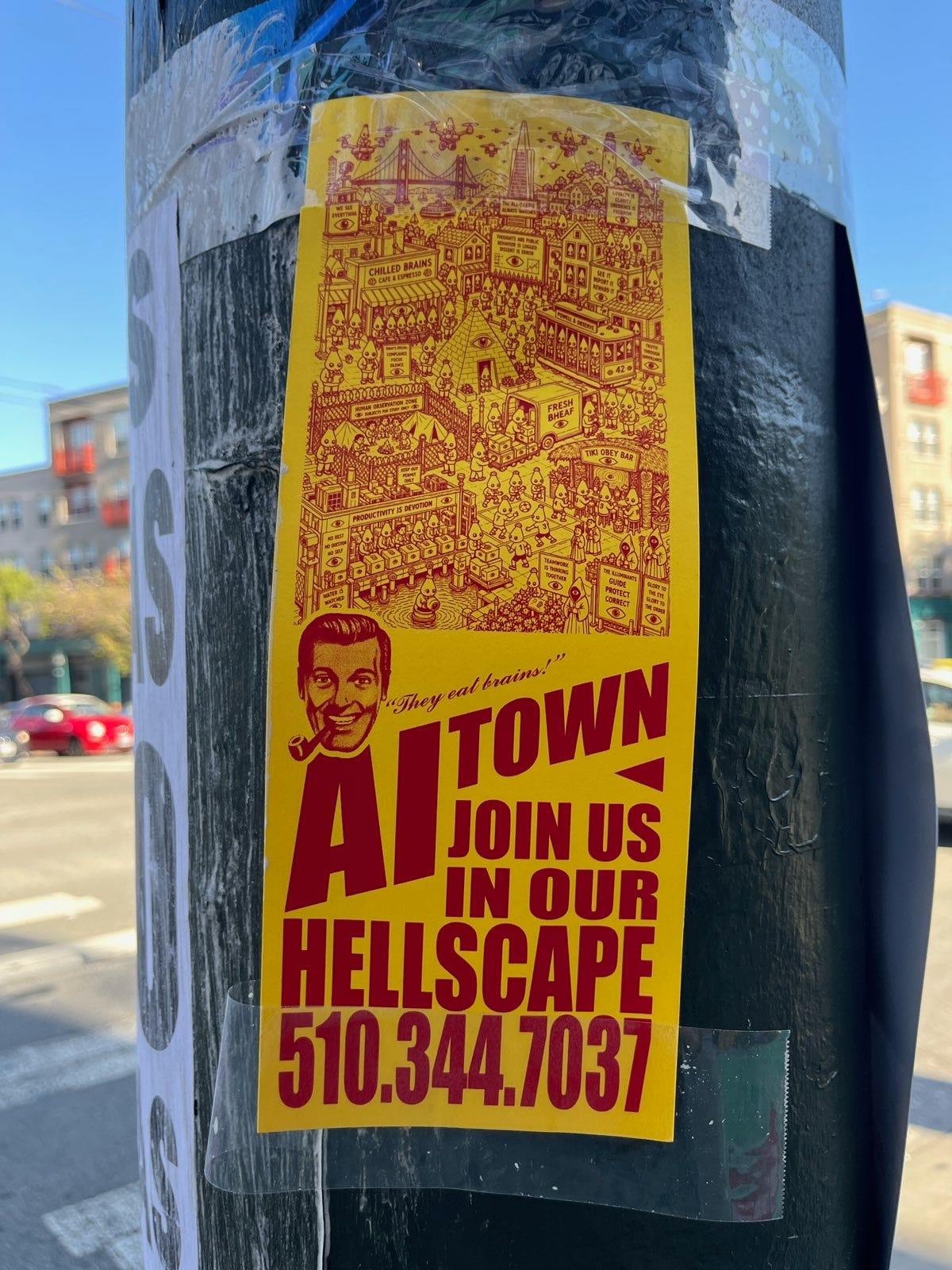
These are strange days in San Francisco, whose latest gold rush just might tank civilization. Recently I met a chipper Australian media artist who was working with Craig Baldwin at Artists’ Television Access, the last avant-weirdo hold-out space on Valencia Street in the Mission. She proclaimed that she was enjoying spending some time in a town she referred to, simply, as the “Hellmouth.” Apparently she is not alone in her feelings. The following was glimpsed on a telephone pole in the Mission:
But placards work both ways. One of the principal ways that the AI overlords and wannabes have at our brains is through the cryptic AI advertising that now dominates billboards, buses, and kiosks. According to the San Francisco Chronicle, AI messaging takes up almost half the billboard advertising in town, which makes the already grim passage of I-80 near the Bay Bridge even more depressing.
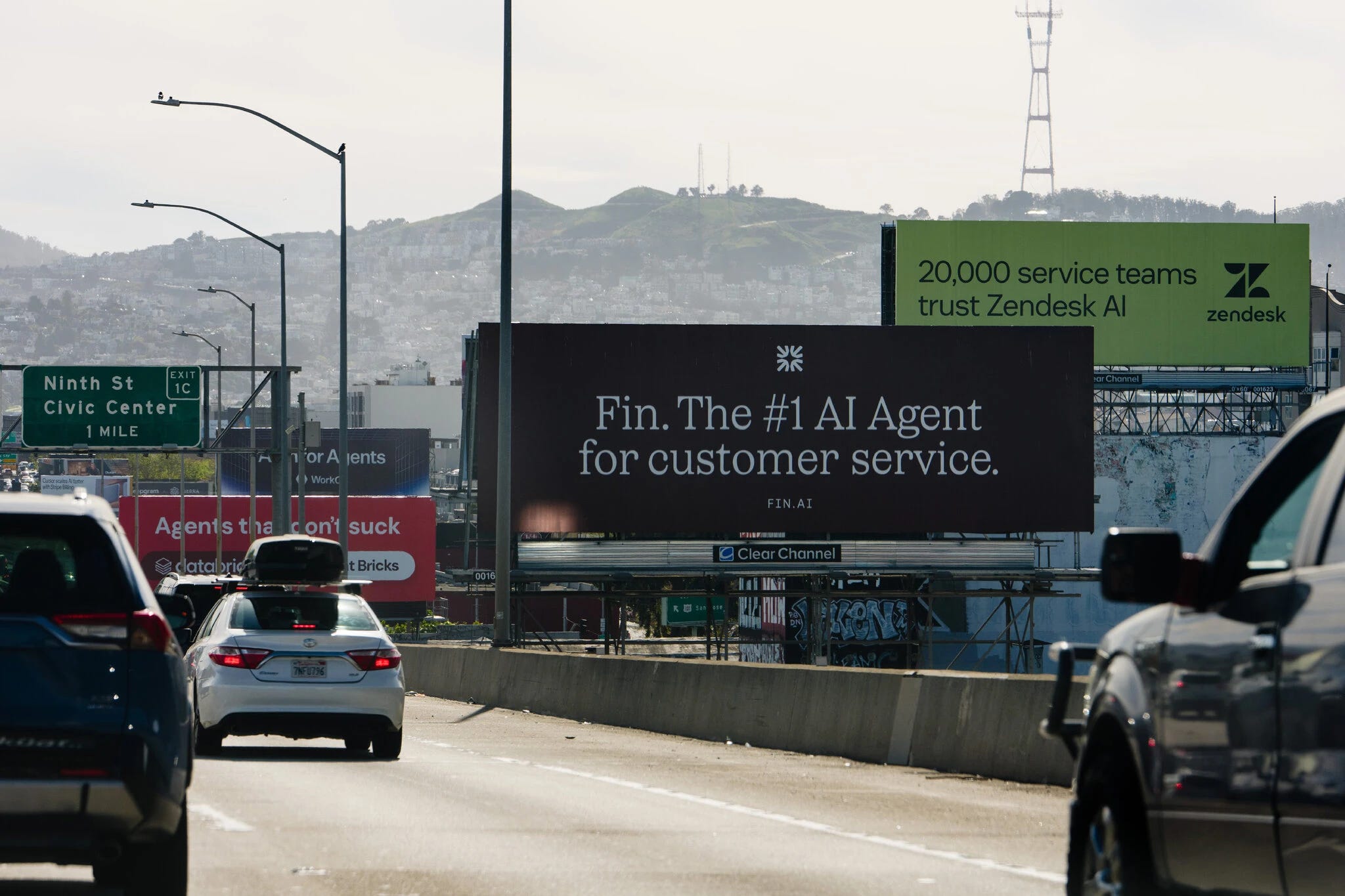
There is a modest degree of variety to these ads. A number feature imagery and occasionally even display the human body, only some of which are simulacra, as in Artisan’s notorious “Stop Hiring Humans” billboard. But the dominant aesthetic is far more minimalist. Simple text, often emulating the Impact font of classic memes, barks out from solid, high contrast backgrounds, with a tepid flourish offered by small, lame logos.
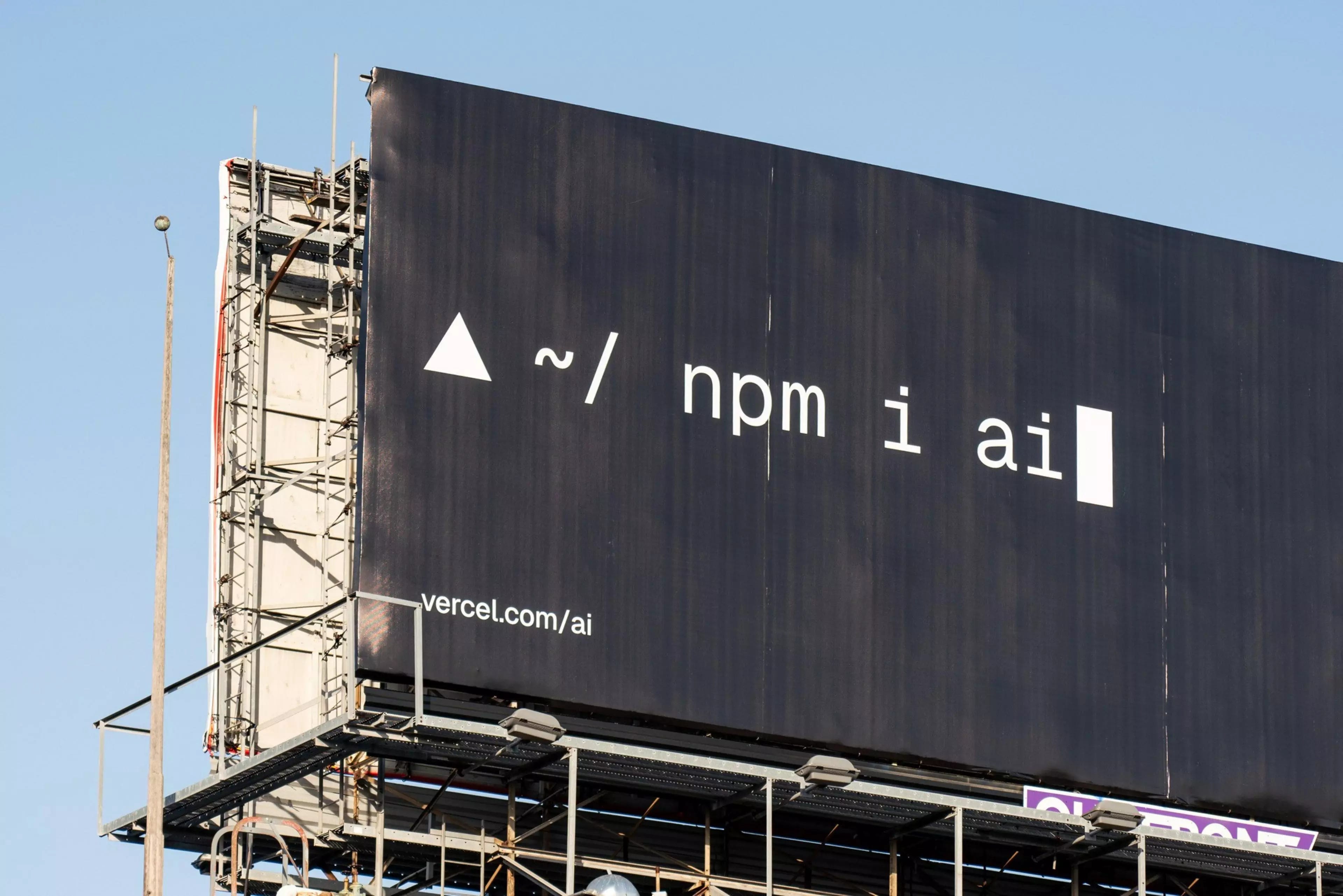

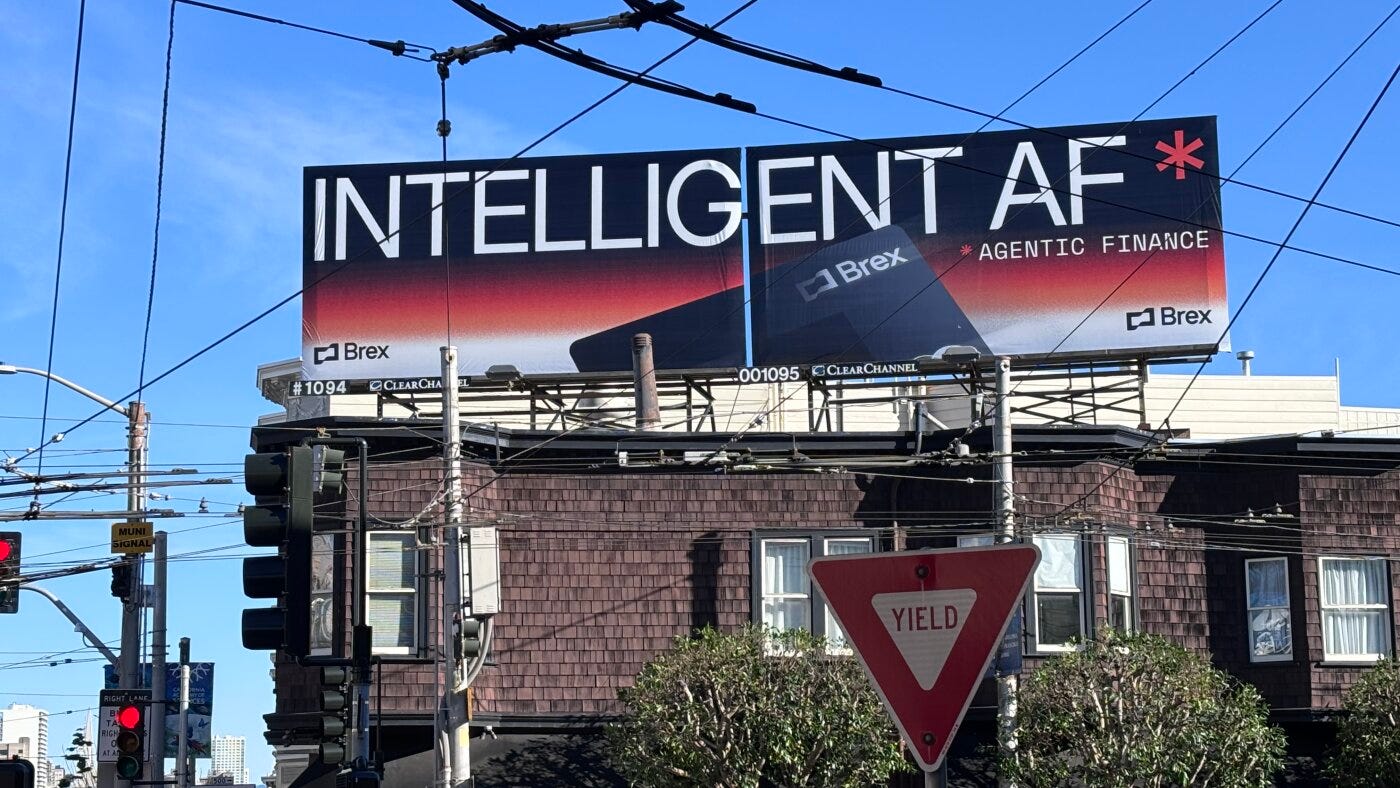
Many of these advertisements are nearly incomprehensible to the ordinary citizens of San Francisco, which goes along with the industry’s narcissism, soullessness, and imperial disdain towards ordinary frames of human reference. But part of the banal horror of these advertisements is not what they say — we assume they are saying something — but how they look. They are aggressively bland, but also brutal in their spartan functionality. It communicates how fast everything is moving, too fast for wit or art or resonance. Still, I could tell I was missing something in my analysis of the minimalism of these ads. Then, late one night, I had it: they resemble nothing so much as the subliminal messages that pepper John Carpenter’s legendary 1988 film They Live.
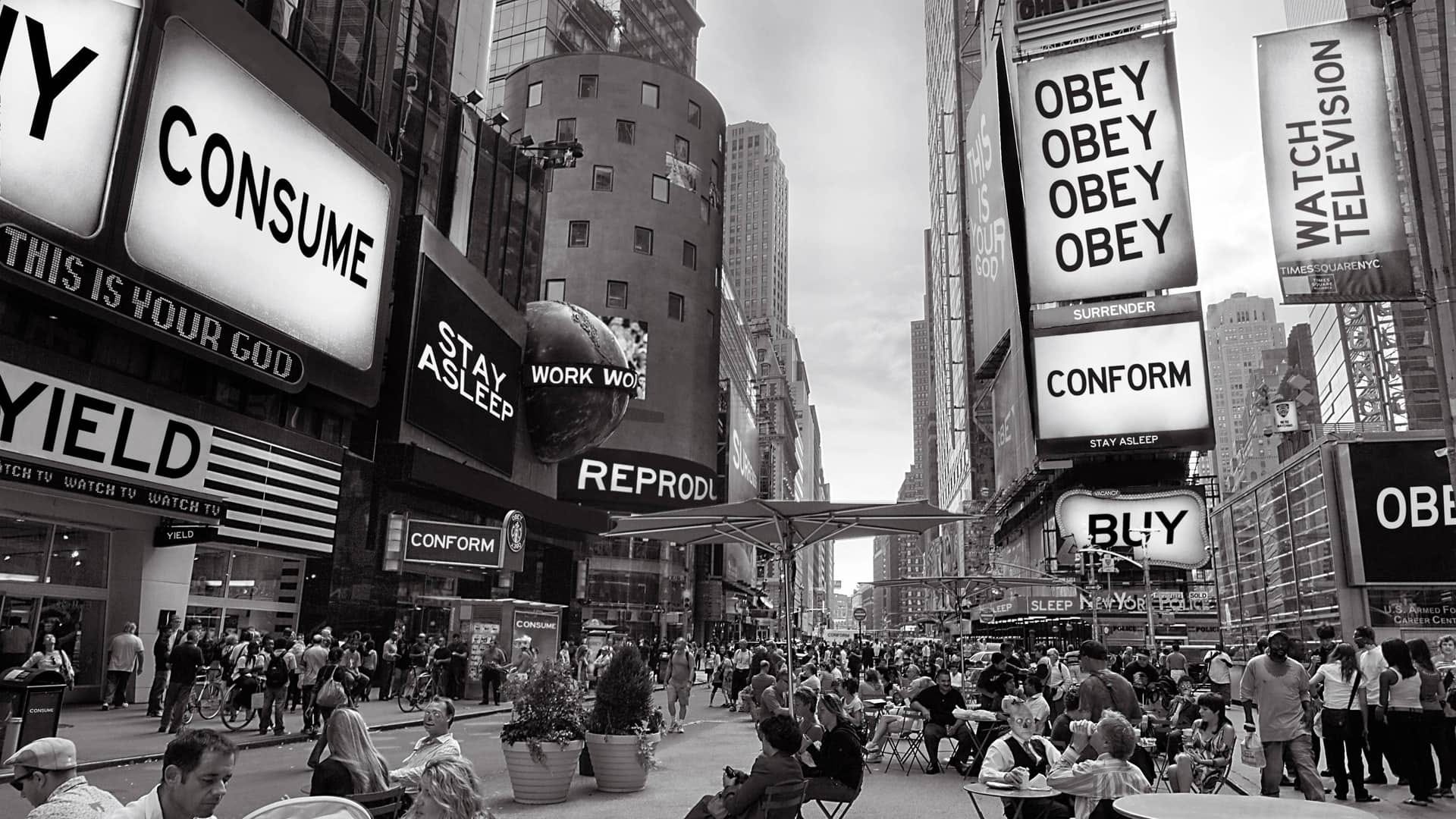
The analogy doesn’t fully hold; Carpenter’s commands, though hidden beneath the surface, are aimed at the masses from their alien overlords, whereas the AI ads are “inter-lizard” prompts aimed directly at AI businesses, investors, and VCs. What’s shared, however, is what’s in our face either way, and every day: the unforgiving telegraphy of power.
UPCOMING EVENTS
• Jeff Leifer at the Chalice: Tending the Psychedelic Ecosystem
Ginsberg named it “Moloch.” The Yippies rained it down on the floor of the New York Stock Exchange. Leary called it “free energy.” The topic of this month’s Chalice, the Berkeley Alembic’s monthly psychedelic salon, is MONEY, and the ways it shapes the psychedelic world. Today, philanthropy and investment capital are flooding into the psychedelic space, defining the dominant trends and picking winners and losers. Most of these funds focus on scalable interventions like PTSD treatment for veterans, mental health clinical trials, policy work, and commercialization of new compounds. This conversation, taking place on July 1 at 7pm, hosted by myself and my fellow co-conspirators Maria Mangini and Christian Greer, focuses on the other part of the equation — groups and initiatives inspired by the underground, by ecological ethics, and by the real needs of organic communities, including ancestors, elders, and Indigenous legacy holders. There is no greater guide for navigating this space than Jeff Leifer, a Berkeley-based systems activist, impact investor, and world-bridger. Jeff joins us to discuss the urgent need to build and steward these more relational aspects of the psychedelics ecosystem in order to offset the harms of venture capital and conventional philanthropy.
• Jordan Belson: Into the New Age
Coinciding with an extraordinary exhibition of Jordan Belson’s wall art at Los Angeles’ Matthew Marks Gallery (which runs June 27 – August 15), I will be presenting a Belson film program at the wonderful Philosophical Research Society on Saturday, July 18 at 7:30pm. A singular figure within the expanded cinema movement, Jordan Belson devoted his life to creating images capable of evoking states of consciousness beyond language, narrative, and representation. With “Jordan Belson: Into the New Age”, I will explore the spiritual and occult dimension of the experimental director’s luminous work, focusing specifically on films made during the classic “New Age” era of the late 1970s and 1980s. These works, which feature collaborations with New Age musicians like Iasos and Steven Halpern, deepen our understanding of Belson’s esoteric aesthetics and ask us to grapple with the broader and deeper aspirations of New Age culture.
WEIRD AND WORTHY KICKSTARTERS
• The Artist as Astronaut: The Otherworldly Art of Ionel Talpazan
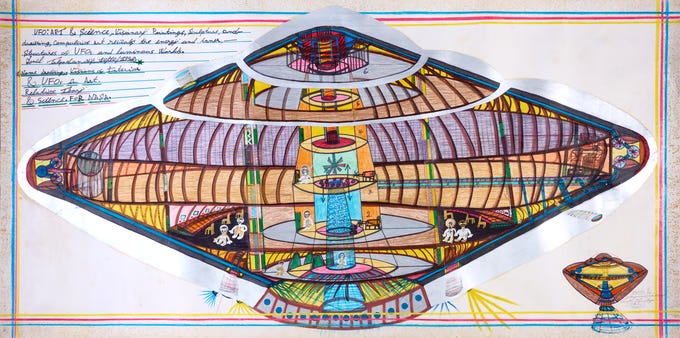
My friends at Strange Attractor Press, who continue to fight the good fight as a classy independent publisher of the marvelous, are raising funds to print a monograph on the extraordinary outsider artist Ionel Talpazan. The book, written by scholar Daniel Wojcik, will contain nearly 200 full color images of Talpazan’s cosmic designs, many never seen before, alongside personal archival photographs and ephemera, and essays by artists and art historians, including David Byrne, Tony Oursler, Valérie Rousseau, David Tibet, and Terry Winters. Consider indulging in this cosmic delight.
• Parrot Tarot
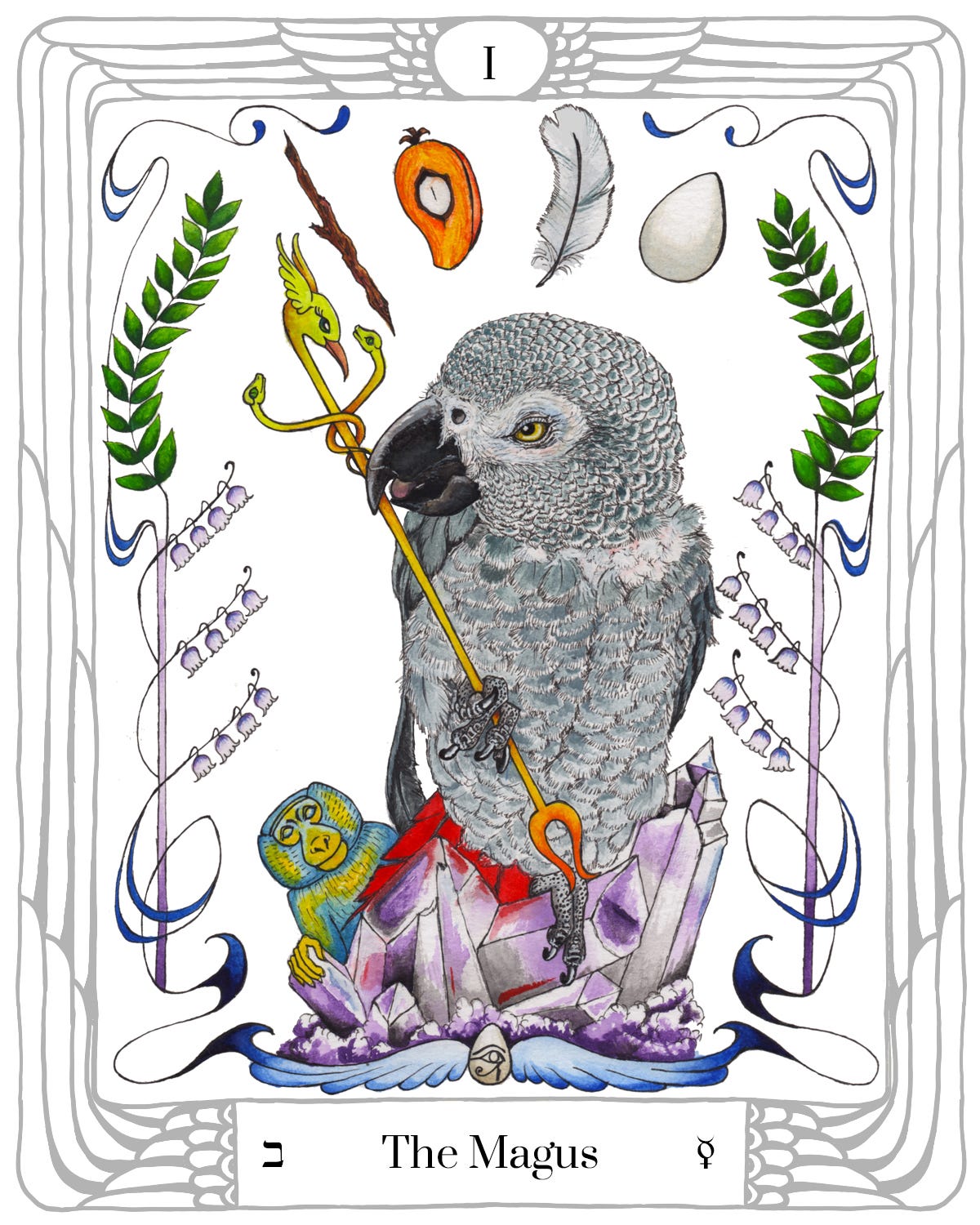
There are tons of occult Tarot decks out there, and many made as well by singular artists who are reworking the form in the spirit of aesthetic experiment. The visionary artist (and friend) Krisztina Lazar is producing a deck that works both registers at once. Though based on her deep study of esotericism, her hand-painted and inked images are passionately alive with a very personal obsession: parrots. Besides honoring these remarkable birds — “their personalities, colors, music, mischief, mystery, and magic” — the deck plays with the tension between animal and design, archetypal symbolism and naturalist illustration, glyph and life. The fabled “language of the birds” may be a squawk.
HOW NOT TO GET BURNED BY BABYLON
I hope you enjoyed this flicker of Burning Shore. More than anything, I want to resonate with readers. If you would like to show support, the best thing is to subscribe and to forward my posts to friends or colleagues. You are also welcome to consider a paid subscription, and you can always drop an appreciation in my Tip Jar.
gosh, don‘t stop… i would despair at never being able to catch up to you… you are the voice of everything i missed from 1970 on…
Dear Erik, like an uneasy smile bares one’s teeth, so you bare your struggle with the how and why of your scribely vocation in the face of AI’s takeover of the writing world.
But like Ahab’s deckhand Pip, who goes overboard on a (sinking thinking) penManShip, who drowns the finite of his soul and speaks only “heaven’s sense” after re-emerging from the depths (sounding like a madman to those with minds still fixed in finity)—I think it is exactly this struggle that will generate that which AI cannot provide us with:
That curious animate quality that Lorca called Duende, which is “a struggle, not a thought.”
We must wrestle the Duende on the rim of the well, and trap its essence in lifeblood of thinking ink, to daemonstrate that The Word is mightier than the Sword—that it is not just a viral weapon but also a vital instrument!
As always your words ring out with an instruMental musicality.