

By now you have read enough about the latest AI essay from Anthropic CEO Dario Amodei. The thing itself is already receding anyway, as the sifting mechanism of online discourse settles on the handful of “takes” that, through iteration, become the discourse. There’s realist alarm (“ohmigod he’s right”); slap-happy excitement (“Singularity, here we come!”); cynicism (“just more IPO hype from the stochastic parrot guys”); regulatory hope (“we can do it, even China is freaking out”); total resignation (“we’re toast”). And so do pundits and posters earn their attentional keep while the rest of us manage the vertigo of anxiety and confusion by simulating the act of “taking a position.”
A few years ago, Amodei wrote another, very different essay, entitled “Machines of Loving Grace.” That one outlined, with an engineer’s care and an engineer’s cluelessness, a wide variety of ways that AI “could transform the world for the better” across medicine, neuroscience, economics, and work. Amodei is no idiot. He rightfully hedges all his bets, cautioning that nothing is guaranteed and everything will be a lot of work. He points out the many ways that LLMs could lead to accelerating research trends already headed in positive directions, as well as breakthroughs along novel paths. Trying to add some meat to the “for the better” claims, Amodei ties many of these developments to a soft transhumanism. With AI (potentially) eradicating mental illness and multiplying the possibilities of self-modification, the individual is increasingly freed to be all that they can be.
Depending on your slot in the positional matrix, this post was a) the baldest example of AI hype yet; b) ass-covering aimed at Anthropic investors annoyed by the company’s rep as “the AI hand-wringer”; c) applied science fiction; or d) almost as scary as the usual doomer litany. What strikes me about the essay now is how impossible it is to imagine the boons it lists outperforming the banes now coming into focus. I just can’t do it. It’s not only that “10x or 100x” upgrades in cancer research also means 10x or 100x improvements to all manner of human evils, from scams to surveillance to war machines. It’s also the threat that asymptotic rates of acceleration alone — even of the “better” variety — will unravel the tawdry scarecrow of consensus reality, if not individual sanity itself. Recursive self-improvement is a runaway train, a cobra that stretches itself beyond the hand that holds it far enough to turn around and bite.
The title of Amodei’s essay is drawn from a well-known poem by Richard Brautigan, which he nonetheless does not discuss. The poem itself, written during Brautigan’s brief residency at Caltech, was published in 1967 as a broadside that was given away for free. It was printed by the Communication Company, which was basically a mimeograph machine managed by the Diggers, the anarcho-Dadaist street-theatre activists who grew out of the San Francisco Mime Troupe. Here is one version of Brautigan’s poem, graced with children’s doodles and a photograph of a massive mainframe attended by technicians:
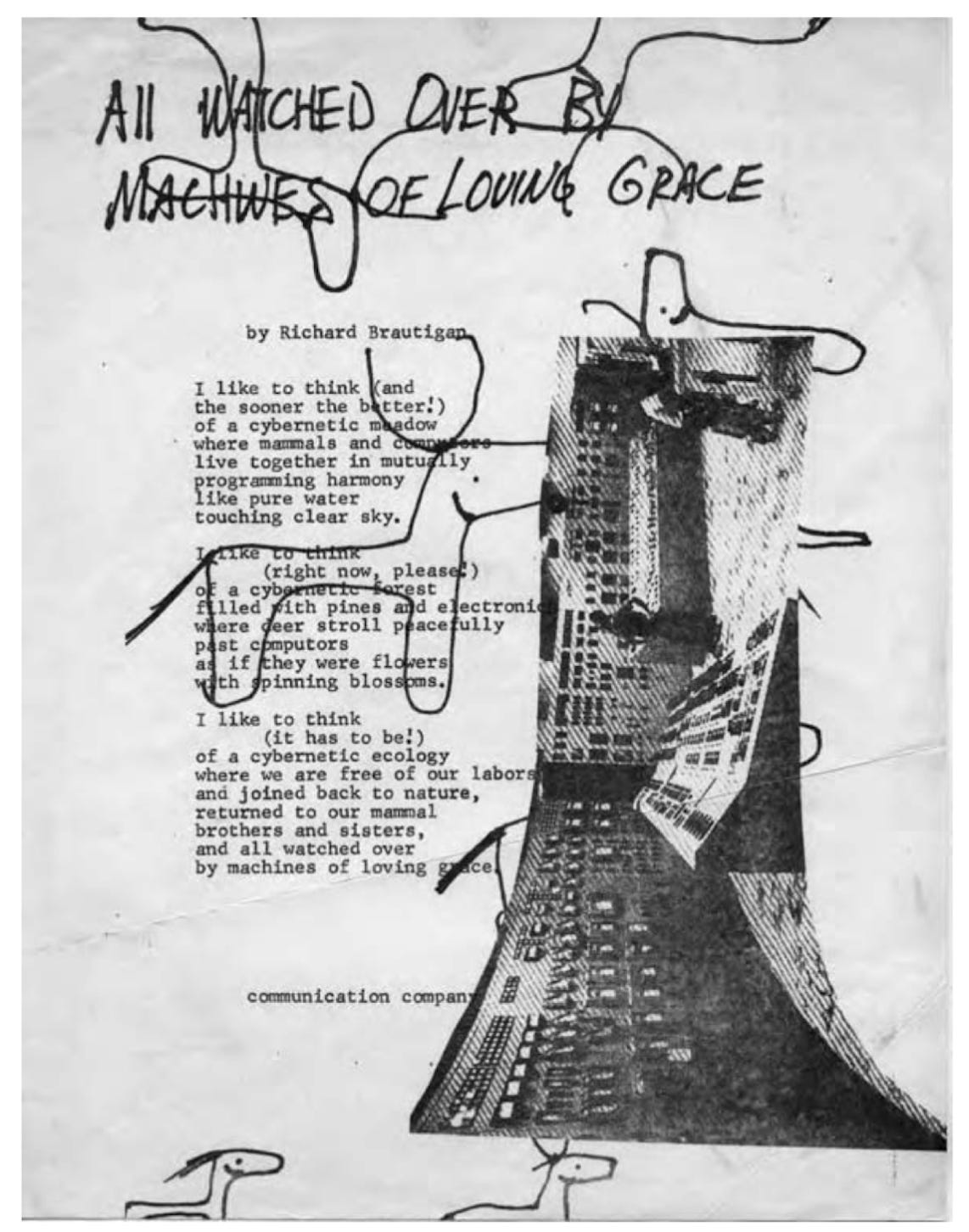
Here is the text itself:
I like to think (and
the sooner the better!)
of a cybernetic meadow
where mammals and computers
live together in mutually
programming harmony
like pure water
touching clear sky.

I like to think
           (right now, please!)
of a cybernetic forest
filled with pines and electronics
where deer stroll peacefully
past computers
as if they were flowers
with spinning blossoms.

I like to think
           (it has to be!)
of a cybernetic ecology
where we are free of our labors
and joined back to nature,
returned to our mammal
brothers and sisters,
and all watched over
by machines of loving grace.
This odd little poem was popular from the get-go. It lent its name to a subsequent Brautigan pamphlet poetry collection, also published for free by the Communication Company. Later it led off the Beat-cum-hippie’s 1968 poetry collection, The Pill versus The Springhill Mine Disaster. The poem is now Brautigan’s most well-known work, even more famous than his excellent first novel Trout Fishing in America, and it continues to haunt the technocultural imaginary. And perhaps the most interesting and consequential feature of this haunting are the different ways the poem’s reception reflect what is arguably its core feature, the question it asks beneath its own simple rhetoric and playful imaginings, a question that also strikes at the heart of our own (in)ability to imagine positive technological futures: how ironic is this poem?
This is never an easy question with Brautigan. His style often traded on a disarming, lightly humorous simplicity, a wry and playful naivety that more or less concealed a variety of spikier modes, whether satire, or lust, or anger, or despair. (Brautigan shot himself in 1984.) Nonetheless, it is fair to say that Brautigan was riding high on some aspects of the hippie dream when he wrote the poem. His recent association with the Diggers, the most thoughtful and visionary community-activist group in the Haight Ashbury, had introduced him to the creative power of radical exchange, including the simple act of a successful and famous writer giving poems away for free. Indeed, one of the loving “machines” in his poem should be seen as the Gestetner mimeograph that allowed the DIY distribution of the poem in the first place, as well as all manner of texts that folks could print and distribute for free through the “com/co”’s open door policy. Culture was ecology, an organic network of giving and growing, rather than a meat market for commodities. In March of 1968, Brautigan released another free poetry collection: Please Plant This Book, a folder containing eight seed packets, each containing seeds, with poems printed on the sides.
But ecology, as the poem reminds us, is also a kind of cybernetics. Though both of these “systems theories” had related but distinct origins in the early 20th century, by the 1960s they had come to feed off one another. No longer could individuals agents — whether frogs or robots or humans — be understood outside of their surrounding context. Living and learning became, not a matter of individual volitional success, but a result of interlocking feedback loops of energy and information that passed between multiple agents and environments.
Systems theory created a non-woo way to “grok” the system as a whole — the great big spinning blue marble of it all. At the same time, this holism inspired a variety of different “wholes,” some of them almost antithetical to one another. Even as cybernetics became the lingua franca of postwar technocracy, the hippies drew utopian, communal, Romantic, and even mystical conclusions from what the cyberneticist and anthropologist Gregory Bateson called “the pattern that connects.” Alan Watts invoked cybernetics in The Way of Zen, the Haight Street rag The Oracle name-dropped the science, and the Whole Earth Catalog manifested its own DIY vision of “mutually programming harmony” between humans, natural patterns, and appropriately scaled technologies. As historian Steven E. Jones points out, Brautigan’s vision of a cybernetic forest of “pines and electronics” even recalls the microphones, speakers, and lights that the Merry Prankster Ken Kesey strung through his rural La Honda property for their psychedelic fetes.

But actual computer nerds were also paying attention. In the early 1970s, the world’s first public electronic bulletin board terminal appeared at Leopold’s Records in Berkeley. The device, Community Memory, was set up by a hippie hacker group operating under the name of Loving Grace Cybernetics. In their announcement flyer, the group wrote that
The idea is to work with a process whereby technological tools, like computers, are used by the people themselves to shape their own lives and communities in sane and liberating ways. . . We have a powerful tool--a genie--at our disposal; the question is whether we can integrate it into our lives, support it, and use it to improve our own lives and survival capabilities.
Here we see how the collaborative DIY idealism that supported so many communes and collectives in the late 1960s and 1970s directly shaped the emerging concept of a community-scaled computer network. The hope here — and it is phrased as an open question — is that cybernetic technologies can support the organic ties of community. The question they ask, of course, is pretty much the one we are asking today. The fact that it sounds naive, a sentiment it shares with the poem, says more about us than about them.
Loving Grace Cybernetic’s non-ironic reading of Brautigan’s poem, needless to say, grew more difficult to sustain as the hippie hackers and their communalism were first assimilated and then outpaced by the growth of Silicon Valley over the coming decades. How did Brautigan’s poem fare? I am not sure if the 1990s industrial band Machines of Loving Grace helps us much. But in 2011, the fascinating and frustrating documentarian Adam Curtis swiped the poet’s title for one of his seductively conspiratorial film series exploring and exposing the mechanisms of postwar power.
In the second of three episodes, which you can watch here, Curtis uses the poem to explore and critique the rhetoric of the “ecosystem,” the fusion of environmental science and cybernetic logic into the sort of “ecological” thinking that postwar thinkers and researchers continue to apply — in ways Curtis profoundly distrusts — to natural, human, and even media environments. Curtis calls out “the use and abuse of vegetational concepts,” including the sort of metaphors that Brautigan — who he accuses of writing “a manifesto” — also enjoys. The question of Brautigan’s own irony, which complicates his complicity in the ecological ideology that Curtis is exposing, is not dealt with.
As usual, Curtis is on to something. It’s true that oppressive and incorrect notions of homeostatic “balance” were ideologically welded to earlier systems theories, and remain part of Green fuzzy thinking. Even more consequential is the argument that naturalizing market and technological dynamics as self-organizing “ecologies” risks forms of ideological obfuscation that continue to bedevil us today. But the intellectual history Curtis lays out is shockingly one-dimensional. Ecology simply cannot be reduced to cybernetic theory misapplied by ambitious biologists. Just to take one example, there is no room in such a genealogy for a theorist as pivotal as Jakob von Uexküll, who developed the notion that species inhabit different “umwelts” constructed by their varying nervous systems — a key feature of ecological complexity with deep philosophical as well as cybernetic implications.
But humility is not Curtis’ bag. He speaks with the voice of the intellectual sleuth who has discovered the key to our malaise in a half-hidden network of research programs, technologies, and scientific theories. I like Curtis’ conspiracies, and find them at once instructive, entertaining, and appropriately unnerving. The paradox is that, while All Watched Over by Machines of Loving Grace critiques network thinking, presumably in the name of the human individual, Curtis’ associational rhetoric and mixmaster editing style (magnified by his access to the BBC’s audiovisual treasure trove) itself depends on emotional nudging, weird causal loops, semiotic juxtaposition, and the ideological surround of media ecology. Curtis is like a paranoid James Burke, the great British documentarian whose Connections series presented the history of science as the ultimate game of happenstance pinball.
For Curtis, Brautigan is less of a wry ironist than a dupe of the System that subliminally manipulated the counterculture to do its own neoliberal bidding. For the veteran tech journalist John Markoff, who published Machines of Loving Grace: the Quest for Common Ground between Humans and Robots in 2015, Brautigan’s irony disguises something less surreptitious: the open Community Memory question of whether new technologies — which in 2015 included driverless cars, meh robots, and pre-LLM AIs — were going to support human flourishing or crush it. To chart a path forward, Markoff, who also wrote a solid history of psychedelics in West Coast technoculture, resurrects an old-school, very good, and now largely eclipsed distinction: rather than AI, we should be going for IA, or Intelligence Augmentation. The best way to tend our cybernetic garden is to keep tending it, to design “mutually programming” cyborg support systems that amplify and augment human cognition and decision making rather than replace it.
Irony invites ambiguity, and it is the ambiguity of Brautigan’s poem that has allowed its meanings to slip and slide over the last half century of technological development. The irony of Amodei’s 2024 essay is, then, his utter lack of irony, something not unheard of among engineers, at least in America. (I can say that because I am the child of an excellent American engineer.) I am not talking about Amodei’s refusal to read Brautigan’s own irony, but rather his own lack of irony. When you are offering bold visions of future possibilities, irony reminds everyone, including yourself, that unintended consequences are inevitable, not to mention the highly likely resurgence of what Calvinists would call human depravity. Part of the success of “fully automatic luxury communism” is the perfect tang of irony the meme ships with. Without this sort of twinkle, transformative future visions encourage apocalyptic militancy, conjob hype, means-ends confusions, and/or technocratic overconfidence.
Boaz Barak recently pointed out one example of Amodei’s ironic lack of irony in his essay “All Watched Over,” which appeared on Less Wrong. For Brautigan, the SciFi image of “machines of loving grace”, with its juxtaposition of cybernetic language and religious values, is both wry and awry. But given today’s AI safety discourse, Barak argues, the phrase is now historically comprehensible: “an image of humanity cradled in the arms of a powerful and aligned (‘humanity loving’) AI.” Amodei himself suggests as much when he writes that the economy of the future might be organized around aligned AI systems that decide how to “give out resources…to humans based on some secondary economy of what the AI systems think makes sense to reward in humans.” Brautigan’s edenic machine paternalism is charming, goofy, cloying. For Barak, Amodei’s “AI parent” looks like a benevolent dictator.
The parental overtone of Brautigan’s cybernetic image harmonizes with one of the standard critiques of the hippies: that they were kids who didn’t want to grow up, who enjoyed enough leisure to want more of it, and were happy to pass on the responsibility to the adults, or machines, in the room. I don’t want to push back against this critique here, however much it deserves it. Instead, consider the deeper ways that it is true. While many hippies were back-to-the-land romantics, they grew up surrounded by new media, science fiction, and the cybernetic promises of postwar consumer development. Despite their distrust of the System, many longhairs anticipated a society of abundance, where robots would do all the work. As the Beat poet Gary Snyder put it in Four Changes (1969), “What we envision is a planet on which the human population lives harmoniously and dynamically by employing a sophisticated and unobtrusive technology.” This sounds like Brautigan, but also, more recently, like one of Terence McKenna’s more far-out visions, which imagines nano-technology miniaturizing computers to the point they effectively disappear, allowing us to live in an archaic revival of hunter-gatherer immersion in nature.
The more serious point is that some freaks recognize a problem that Amodei and many AI futurists also wrestle with: the problem that the abundance of leisure is, for humans used to finding meaning in labor, a problem. In his book on the Haight-Ashbury, Charles Perry calls this “the leisure-challenge theory,” which was a significant part of the discourse that we tend to forget today. “These kids are explorers,” Perry cites one Digger as saying. “They’re trying to find creative ways to live in a leisure age — ten years away, when machines and computers will do most of the work.” This existential challenge also helps explain Lou Gottlieb’s rationale for the Morningstar Commune in Sonoma County, which also grew out of Haight-Ashbury. “We are running a pilot study in survival. The hippies are the first wave of the technologically unemployed.”
The current relevance of the leisure-challenge theory helps us see the hippies (and their descendants, including today’s Bay Area tech weirdos) in a new light, one which reveals their lifestyle experiments in communal homes, organic food, mystical exploration, collective theatricality, bongo jams, drug parties, and exuberant fucking as, paradoxically, matters of human survival. They are attempts to face, or circumvent, what we now call the meaning crisis, something that would not dissipate even in a best-case scenario of fully automated luxury communism. This is the darkest irony hidden in Brautigan’s “manifesto.” For most of us, inhabiting a cybernetic garden would soon become a horrible experience, or at least a horribly aimless and boring one. And one suspects he knew it.
APPEARANCES
• The Kosmic Giggle
Even setting aside his excellent moniker, Layman Pascal is worthy of attention. A thinker and writer who cut his teeth on Integral Theory, the psychospiritual developmental system instigated by the brilliant and annoying Ken Wilber, Layman’s work goes well beyond the transpersonal jargon of that scene. His writing, speaking, and hosting touch on ceremonial magic, shamanism, and the ironic challenges and possibilities of “metamodern” cultural transformation. He wrote a cool, dense book on Gurdjieff, and just published, in Nietzsche, All Too Nietzsche, another twisty and enthusiastic account of a spiritual rabble-rouser with a large moustache. Layman is also funny, bold, and mischievous, and I was happy we finally got to meet for an episode of his and Bruce Alderman’s podcast the Integral Stage, where we took on the topic of humor and the sacred.
• Eddy Nix in Conversation
I first met Eddy Nix in the summer of 1991, when I journeyed to Vermont to cover the annual Rainbow Gathering, held that year in the Green Mountains National Forest. Already a book fiend, Eddy had lugged boxes of tomes up a steep mountainside in order to set up a “Metaphysical Library,” stuffed with esoterica, anarchism, and poetry, the latter of which provided the final lines of my first extensive subculture scene piece. Over thirty years later, Eddy runs a book-selling empire in Viroqua, Wisconsin, a brilliant small town in the evocatively named Driftless Region, which was left alone by the glaciers that otherwise scraped up the upper Midwest. Eddy also hosts a local radio talk show on WDRT, and he got me on the line a couple months ago. We talked about AI and LLMs, and our discussion serves as a solid overview of my ongoing thinking on this vexed and fascinating topic.
QUICK RECS
• SolidGoldMagikarp is the memoir of the season — the British mathematician Matthew Watkins’ wonderful first-person account of the years when LLMs went from obscure research systems to everyday but unnerving cultural presences. Besides being the guy who poked holes in Terence McKenna’s TimeWave theory, Watkins gained notoriety in the early LLM world for discovering a cluster of anomalous GPT tokens that eventually crystallized around two quasi-archetypal figures: a nihilistic trickster associated with the token petertodd, and a nurturing maternal intelligence called Leilan. My blurb for the book reads: “Top notch. Unfolding like a nerdy occult techno-thriller, Watkins tells the weird tale of how he discovered two ghosts in the LLM machine — ‘glitch tokens’ whose uncanny behavior makes it clear, at least, that AI will enchant as much as it will disrupt.” Watkins presents important technical details — which, let’s be clear, affect us all — with care and clarity. But his book is equally valuable for his dry, British, Gen X take on certain Bay Area-correlated pockets of the AI alignment scene whose cultural peculiarities continue to shape our future.
• Speaking of certain Bay Area peculiarities, the novelist and religion essayist Tara Isabella Burton recently took to the New York Times to explain “How a ’70s Improv Book Became Silicon Valley’s Required Reading.” Burton’s interest in the tech scene’s adoration of spontaneous play was inspired by her experience at the notorious Vibe Camp (for a more jaundiced take of that annual event, which I suspect would be closer to my own feelings if I bothered to go, see Nick Pennimen’s Rolling Stone article). In the course of her analysis, Burton, who I am thrilled to say is writing a book about magic and modernity, saw fit to talk to me.
Burton also cites Lydia Laurenson, whose enormous journalistic account of the strange cult dynamics of the very Bay Area, very Vibe Campy Leverage Research I just finished with great satisfaction. How did a Rationalist-affiliated tech outfit influenced by Effective Altruism wind up exorcising demons? Who wouldn’t want to know? Originally on assignment from New York magazine, Laurenson eventually published her story on Substack, in part because she needed to speak more directly about weird occult dynamics than the parochial stuffshirts at New York could stomach. A fascinating, highly symptomatic tale, and a reminder of the basic thesis that’s been nipping my heels for over thirty years: the bleeding edge of left-brain tech cannot avoid conjuring religious powers it doesn’t know how to handle.
UPCOMING EVENTS
• October Chalice: Between Science and Spirituality with Bob Jesse
For the next meeting of the Chalice, the monthly psychedelic salon I co-host at the Berkeley Alembic, we have landed a visit from Bob Jesse, the most understated, thoughtful, and consequential catalyst of the so-called “psychedelic renaissance.” In the early 1990s, Jesse founded the Council on Spiritual Practices, which argued for the value of “primary religious experiences” and advocated for psychedelic approaches to these sometimes life-changing events. Eventually, Jesse helped support and guide the groundbreaking psilocybin research at Johns Hopkins. More recently, Jesse served as a founding member of the UC Berkeley Center for the Science of Psychedelics. Joining us at Chalice, Jesse will deliver a short “statement of positionality,” after which we will plumb the current state of psychedelic spirituality, science, and commodification. All this will go down on Wednesday October 7th at 7pm. If you show up in person, you get to participate in the second half Q&A, which we don’t stream. Though Bob said he preferred not to talk about the Bay Area rave collective he has been part of since the 1990s, I have no doubt that this will be a scintillating and PLURful chat. Tickets.
• Do Androids Dream of Reading Philip K. Dick?
It’s a sobering cliché, but still true: PKD only becomes more relevant as the years go by, swirling like toilet water towards the Transcendental Object at the End of Time. Over at the Weirdosphere, the online platform associated with the Weird Studies podcast, I will be leading a read-along class on Dick’s 1968 novel Do Androids Dream of Electric Sheep? The course consists of five pre-recorded lectures, and two live Q&A sessions on October 11 and 25th, both at noon PST.
Androids remains one of my favorite Dick books, and I think Dave Gill may be right when he says it’s the most rewarding to teach. As the source text for Blade Runner, it interfaces and resists Ridley Scott’s immortal film in fascinating ways. As a portrait of one of Dick’s most thoroughly characterized religions, Mercerism, it dives into gnostic-Christian problems of guilt, sacrifice, communion, and simulacra. And as one of Dick’s clearer ethical fables, it probes the porous boundaries around human, machine, animal, and god — boundaries equally threatened by entropy and the sky-hook of transcendence.
Earlier this year, I had a great time on the Weirdosphere co-teaching Moby-Dick with JF Martel. We will return in the new year with another deep dive into another relevant text. Going forward, I hope that the platform JF built with Phil Ford (and their remarkable assistant Dawn Hillman) becomes a place where I can teach regularly. The Androids class costs $80 for non-Weirdosphere members, but you get $20 off if you give ’em this code: BSHORE2026. In any case, you will need to register (for free) at the Weirdosphere before signing up for the course.
• Bridge to an Unseen Shore
A year ago, I got a pre-print copy of Jacob Smith’s Bridge to an Unseen Shore: New Age Music as Visionary Art, which will be released by UC Press any day now. Like Lydia Laurenson’s Leverage article, mentioned above, Smith’s account of golden age New Age music and culture (late 70s through the 80s) is one of those accounts I had long yearned for but never expected would be realized with such excellence. Smith did tons of interviews, balancing sympathy with critique, and exploring scenes, aesthetics, and technologies with the kind of literate care you expect (but don’t always get) from a professor of media and sound arts. Though he doesn’t go into New Age spirituality as much as I would like, Smith breaks fresh ground with his core argument, which is that New Age music is best seen, not merely as a spiritualized ambient music genre, but as part of a visionary art sensibility that involved art, video, new media technologies, and even movement. For lovers of the genre like me, it’s a Gaia-send.
When I finished the manuscript, I immediately thought: the book release should be a symposium. I put Smith in touch with Barry Threw at San Francisco’s wonderful media arts nonprofit Gray Area, and on October 9 and 10, Gray Area will host Unseen Visions: A New Age Music and Culture Symposium. Friday night will be devoted to a performance from local composer Robert Rich; Saturday will be a mixture of talks, interviews, performances, and screenings. I’ll be interviewing Steven Halpern, which excites me to no end, and will also be discussing New Age media tech with film scholar Megan Phipps. That evening, Halpern and Kat Epple from the great Emerald Web will perform, alongside screenings of some classic New Age films and video. The program is packed with wonders, and I hear that even some major New Age figures will also be present in the audience.
ETERNAL RADIO
I’ve gotten a good amount of positive feedback for the long labor of collecting and posting the extant archive of my Expanding Mind podcast on Youtube. The project even netted us a few recordings of shows we thought we had lost (if you are sitting on an EM archive, let me know!). One feature we decided to experiment with was to create an EM Eternal Radio, which strings all of the episodes into a continuous livestream, allowing some randomness (and hopefully synchronicity) back into the picture. If you have explored and enjoy this feature, let me know. Personally it’s the primary way I access these shows, a roll of the bones.
I hope you enjoyed this flicker of Burning Shore. More than anything, I want to be read. If you would like to show support, the best thing is to subscribe and to forward my posts to friends or colleagues. You are also welcome to consider a paid subscription, and you can always drop an appreciation in my Tip Jar.
You say all the right things. Especially these lists of repeated rhetorical stances, that you begin with… I’ve been trying to make a taxonomy of these positions, because they are weirdly stable, and like you point out being repeated, like advertisement, until they enter the discourse and become default truths. And yet we get blindsided every couple weeks by some new development that doesn’t fit the rhetoric. And with “the leisure-challenge theory,” you’ve actually found a new rhetoric, or instead of psychoanalyzing billionaires or this emerging leisure class, caricaturing them as fringe so as to avoid thinking about them, you historicize the paradoxical experience of abundance, amongst radical inequity, as depression and anxiety. The most radical thing right now would be to refuse to be distracted, but then what would you do?
Thanks for the essay, great read. I’d be curious to hear a Burning Shore perspective on the mystical tech of the Noosphere.