

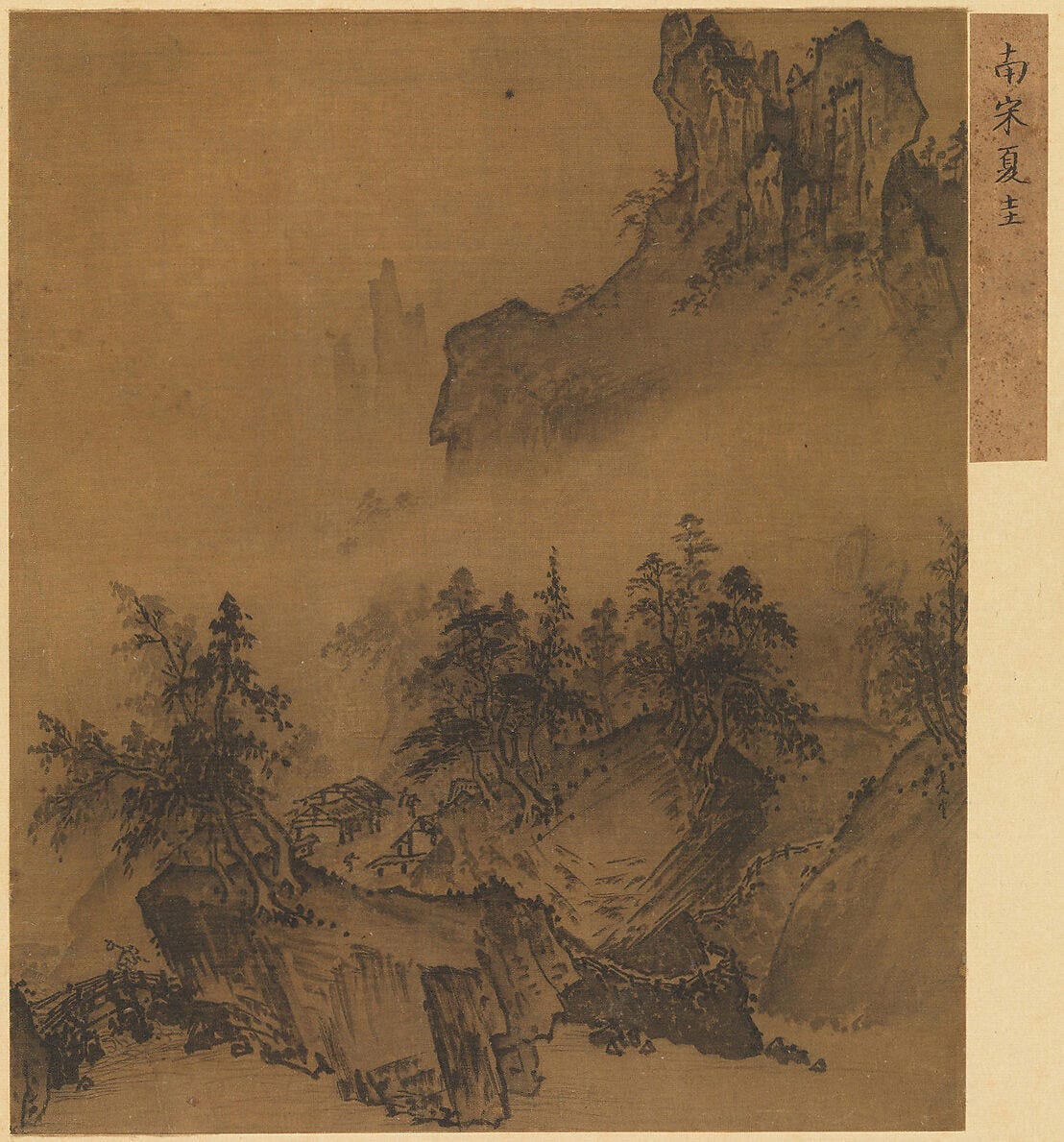
Fayan was going on pilgrimage.
Dizang said, “Where are you going?”
Fayan said, “Around on pilgrimage.”
Dizang said, “What is the purpose of pilgrimage?”
Fayan said: “I don’t know.”
Dizang said, “Not knowing is most intimate.”
— Book of Serenity, case 20
One of the great struggles that jangle our mental ecology these days is the contradiction between, on the one hand, the extensive power and performance of knowing, and, on the other, a profound confusion and uncertainty about what the actual fuck is going on.
What does it mean to know? We are submerged in the deep end of the information age at this point, and the information that’s flooding in, we might say, has a concrete, discrete, and piecemeal character, not unlike the even more atomistic term data. Having a lot of information can be impressive, but it also can be useless without knowing what to do with it. Knowledge, then, is the ingestion and integral assemblage of that information into productive patterns and broader accounts of things. Being knowledgeable stakes another kind of claim than just having a lot of information.
Being knowledgeable is also a kind of stance, a performance of authority, a guise one dons, for oneself or for others, and often whether it is warranted or not. Call this stance the One Who Knows. To judge from contemporary communication networks, from YouTube docs to podcasts to social media — within which I somewhat woefully include Substack — the One Who Knows is an exceptionally successful strategy. The One Who Knows colonizes the voids opened up by the collapse of received authority structures and their traditional sifting mechanisms — from university degrees to apprenticeships, from professional curatorial or editor roles to subcultural gatekeeping, to say nothing of old school inner values like nuance, caution, and shame. Amidst the digital ruins of all these, the One Who Knows can flourish without a shred of collateral, a highly leveraged performance backed up by little more than narcissism, chutzpah, bullshit, and good SEO. Simply by disseminating an aura of charismatic command, the One Who Knows can move needles, drive likes, and attract fans and followers all too happy to relinquish the anxious pressure to actually try and know something themselves — or to honestly face how little any of us can truly know.
Do I sound a bit bitter? Sure. I began to write and think about psychedelics and esotericism decades ago, when these topics actually cost writers social capital, at least in the mainstream intellectual literary zones I aspired to. I proceeded gingerly in these fields, like a budding and careful anthropologist, hewing to the tact and trust-building protocols of the underground, and carefully learning from elders, arcane texts, fellow travelers, and my own first-person experiments. The subsequent “psychedelic renaissance” has been disappointing in many ways, but one of the biggest bummers was having to witness the explosion of newly minted and self-appointed experts — some wearing lab coats, some feathers, others the beige casual wear of therapists or the branded flash of influencers. Mimicking the stance of the One Who Knows, these people were, as often as not, superficial and inexperienced, ignorant of the rich discourse of the underground drug intelligentsia and deeply naive about the compounds themselves and how to navigate their peaks and troughs. And yet this brazen flock of hustlers — “chancers,” as the British wonderfully call such climbers — easily invaded mainstream institutions, popular media, and the interwebs, where, because of prohibition, there were never any structures of authority or seniority in the first place.
I am not a sour grapes guy. I have always believed that, if one sets up shop in bohemia rather than pursuing more legitimate bona fides, then one must remain eternally on guard against bitterness and resentment, especially as you age. I bring this example up only because it was how I got hipped to the contemporary blight of the Ones Who Know. This plague, however, is not simply the result of new kids playing the old game of influence and attention with fresh tools. Instead, it is the tools themselves, and the media ecologies they produce, that seem to breed this surfeit of knowingness, along with so many of its attendant ills: posturing, dishonesty, over-confidence, pigheadedness, readiness to insult, and an ironic quasi-sophistication bred by an excessive immersion in superficial memes, hot takes, and viral trends. In other words, the One Who Knows is, today, a media-tech problem. And the ultimate expression of that problem is chatbot AI. LLMs always play the One Who Knows, even when they don’t know, even when we know they don’t know, and even when the kind of things they are arguably can’t “know” at all.
So what about the not-knowing these Zen coots are goofing around about in the Book of Serenity? Does that have any meaning in our current situation? It’s important to acknowledge here that there are two basic but distinct domains of not-knowing, one of which is conventional and the other existential. There is a relation between these domains, but not a necessary one. The passageway between them is the tricksy part, and where the intimacy comes in.
Conventional not-knowing is often associated with honest and mature assessment about our situation. Most of the knowledge experts I know the best, top-of-the-field folks (both acknowledged by the world and not), readily acknowledge how little “we” really know in those fields, or, at best, how fiendishly complicated everything is, how delicate and provisional the maps and methods are, and how unworthy many of the Ones Who Know are in their own domains. This does not at all mean we stop trying to learn, to understand, and to analyze — these are experts after all. But it does amplify the humility of the situation.
Widen this aperture to include all the fields and sub-fields beyond our ken, and one gets the sense that, even collectively, the knowledge we possess is like so many matchbooks, turds, and plastic bags floating in a seething ocean of WTF, a vasty deep that we might, in the right light — say the magic hour of dusk — read as “mystery,” but that usually feels more like the fog of war.
The conventional plight of not knowing shit is hardly helped by our catastrophic mediascape. If we peek through the portholes of our personal reality tunnels, we face a deluge of contradictory claims, a cataract of rumor, disinformation, and nonsense that seems to gush from the growing cracks in consensus reality. Indeed the tunnels themselves are losing structural integrity. Meanwhile, the Absurd has grown palpable, almost quotidian, as our feeds host a growing cacophony of self-referential algorithmic trash feedback. In the words of Robert Plant, harshing the buzz of firecracker-wielding miscreants in the crowd on some bootleg rip I have somewhere, “it is no longer clever.”
AI turns the knowledge crisis associated with hypermedia up to 11. For even as LLMs take the place of the Ones Who Know, we humans are now actively offloading our own knowing, which may be a relief in the moment but is terrifying in its implications. At the same time, we do hold on to a very important piece of knowledge: that LLMs sometimes hallucinate and will also bullshit us, whether by training or more insidious design.
Their authoritative nonsense, and the distrust and anxiety it breeds, only points to a much deeper and more existential uncertainty. As Butch Cassidy and the Sundance Kid put it in George Roy Hill’s 1969 film, facing an implacable and inhuman posse at their heels, “Who are those guys?” For we know not the nature of these algorithmic entities, these alien minds or unparsable black boxes invading our world. Their statements confound even the nerdy gardeners who cultivated the neural nets that coughed them up — the best of whom, or the most honest, join us in throwing up their hands in amazement and apocalyptic fear. This not-knowing is quite intimate, because it is now in our face.
The silver lining in all of this, if there is one, is the invitation to open up that tricksy passageway between conventional not-knowing and a deeper, soul-making mode of not-knowing. The existential risks of our moment, in other words, have bred a return of existential questions, which are precisely those questions that we cannot answer but must endure, not unlike the way we endure our own mortality (until we don’t). Who am I? What are humans for? Where are we going? What is truth? What is consciousness? Is meaning in the world or only an appearance? Could it be both? These, again, are not questions you resolve but questions that draw you deeper and more intimately into the unknown. At the end of the day we are all Mysterians.
As anxieties and confusions mount, as the world accelerates its vexed mutations, these questions increasingly become everyday arrivals, slicing between more mundane concerns with gas bills and Dad’s Fox TV addiction and what the fuck is wrong with my email server. There we are, trying to know, and the One Who Knows Not whispers in our ears. “Who do you think you are anyway?” The invitation to not-know, again, does not mean abandoning decision-making or analysis. It means holding them lightly as we navigate the passage between Not-Knowings, acknowledging the limits of conventional knowing, both ours and others, while opening up to the inner being who is unruffled by uncertainty and ambiguity.
In a wonderful talk on the Book of Serenity case quoted above, the Zen teacher Norman Fischer wrestles with this dialectic of knowing and not knowing. “Experience, knowledge, wisdom – these are good, but when I examine things closely I can see that they remove me from what’s in front of me. When I know, I bring myself forward, imposing myself and my experience on this moment. When I don’t know, I let experience come forward and reveal itself.” Not knowing is not just a condition then, but a practice. This practice is not unrelated to what the Baysian nerds mean by “updating your priors” but it goes farther, if with much less cockiness. “When you train in being present and letting things come and go you are training in not knowing. Within not knowing we make determinations and take actions. Every moment calls on us to respond and we do, freely and with full confidence. Sometimes affirmation is called for, sometimes denial. There are no rules. But whichever it is, we don’t settle down there. We don’t identify and dig in. We stand in not knowing, ready for the next moment to be different.”
There is still something ameliorative here, something workable, even upbeat. That inspires me, though I do not always trust it. The sort of not-knowing he describes here also dovetails in my mind with a darker passage in M. John Harrison’s new post-apocalyptic novel The End of Everything, a novel very much concerned with no longer being able to know the world. I can’t get it out of my head, so resonant and accurate it seems.
We’re suspended in this new catastrophe. We’re held in suspension. It’s ongoing and unresolved. It never ends. The nature of the catastrophe is that it has no nature.
I have more to say about Harrison’s fabulous book below. But now a word from our sponsor.
UPCOMING EVENTS
• Superstar: The Psychedelic Jesus of the Counterculture
On Sunday, November 29, at 7pm, I will be giving an illustrated lecture at Los Angeles’ Philosophical Research Society exploring one of my all-time favorite topics: the psychedelic Jesus Christ of the counterculture. With the contemporary emergence of a new Christian culture of psychedelic healing, and of recent texts like Wendi Rees’ The Christian’s Guide to Psychedelics and Rob Zahn’s LSD to Galilee: Incarnation in the Psychedelic Subculture, the question is of more than historical interest. Some folks hope to scrape up mushroom residue from the chalices of the early church, but there is a much more recent source of psychedelic Christianity: the counterculture. From acid visions, underground comics, and esoteric “freak” circles to the emergence of the Jesus Movement, I will trace the surprising intersections of psychedelic experience, Christianity, acid rock, and art, including the work of legendary illustrator and sometimes born-again Rick Griffin. The talk will also be streamed.

• TRANSMUTE: the History of Consciousness in the West, with Earl Fontainelle
Earl Fontainelle is a marvelous historian of ideas who specializes in the cross-over of religion, philosophy, and magic in the ancient world. As listeners to his cult podcast The Secret History of Western Esotericism already know, Earl brings a funny, articulate, and good-humored enthusiasm to his esoterica. On Friday, December 11, at 7pm, the Berkeley Alembic and I will be hosting Earl for a mind-expanding discussion of Platonism, a philosophical tradition that also was (and is) a practice — a path of cultivating altered states of consciousness that embrace the cosmic and even psychedelic. As Earl puts it, “Although Plato had no word for ‘consciousness’, his thought pointed towards the vibrant territory where modes of mental experience and features of Being are revealed to be two incomplete ways of describing supreme reality.” This event also inaugurates TRANSMUTE, a quarterly-ish series of talks, discussions, and screenings that I am curating at Alembic, and that is dedicated to an expansive conversation about consciousness that draws from religion, philosophy, technology, and the arts.
• Chasing the Sandworm: Reading Dune as Prophecy
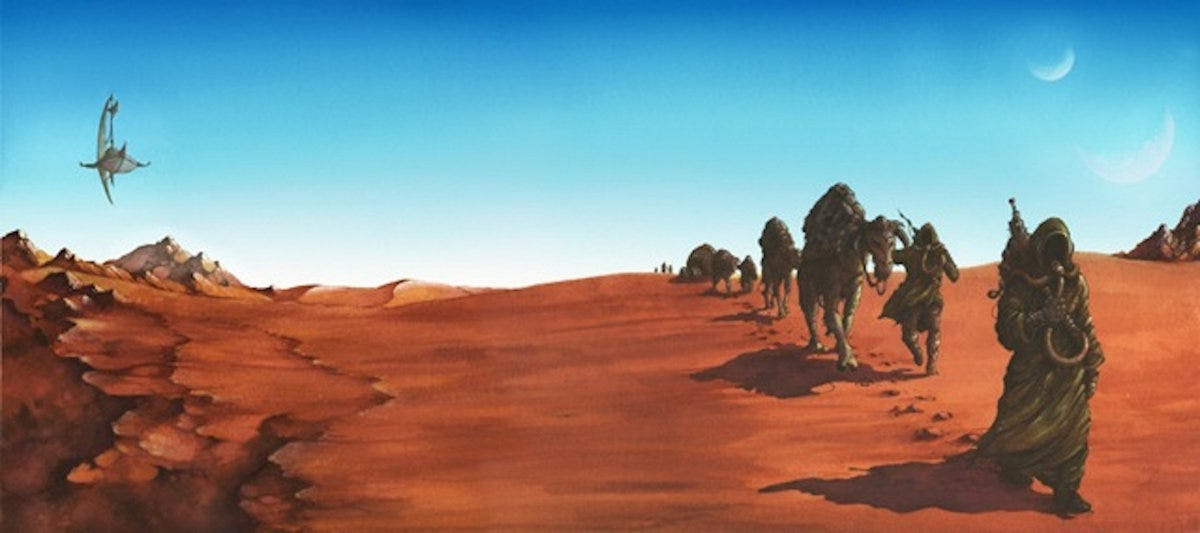
Following up last January’s wonderful course on Moby-Dick, J.F. Martel and I will be teaming up again over at the Weirdosphere to collaboratively take on another classic starring a monster of the depths: Frank Herbert’s 1965 novel Dune. In this five-week course, which begins Thursday, January 7, J.F. and I will approach Herbert’s classic from multiple angles: from ecology and the rise of environmental consciousness to oil and the geopolitics of scarcity; from chiliastic religion and social engineering to the postwar California legacy of psychedelics, parapsychology, and the human potential movement. As usual, we will draw on the work of diverse thinkers and artists in exploring Dune. Participants can expect brushes with Martin Heidegger, Alan Watts, James Lovelock, Ibn Arabi, Carl Jung, Max Weber, David Lynch, and others. Focusing on a set number of chapters each week, the course is designed for participants to read along with the instructors, be it for the first time or the seventh. Burning Shore readers can claim a 10% reduction in the course price by following this link.
THE END OF EVERYTHING
One of the many marvels of M. John Harrison’s The End of Everything is the haunting manner in which it both reflects and enacts the texture of not-knowing today. Its peculiar pages rhyme with the uncanny banality of our befuddlement, as well as our exhausted if sometimes poignant submission to nonsense, fragmentation, and the sort of ominous data points that might bloom into conspiracies if we only possessed the energy or naivete to manufacture the system of sense required.
I don’t want to say too much about the novel, which you should just read. It’s short, very beautiful, and the Audible reader is top-notch. It says more about the age of AI than a thousand insider Substacks. We begin in a weird post-apocalyptic landscape that is also the ragged, entropic coast of southeastern England. Phillip is a beachcomber who comes away with an animate, quasi-human “artefact” he brings to his aunt Marnie, a painter who is sinking into dementia, or perhaps consonance with the uncertain and nonsensical world everyone now inhabits. The cause of the catastrophe is the arrival (perhaps) of the iGhetti, whose motives, origins, and nature are essentially unknown. They are interdimensional beings of some sort, extruded from a “space that wasn’t quite in the world,” a space that might have something to do with financial crises, or the Internet, or even the possible tourist gentrification of our planet from aliens hungry for their own “re-enchantment of the world.” But it is the nature of the catastrophe that is important — a nature that has no nature, and so cannot be known.
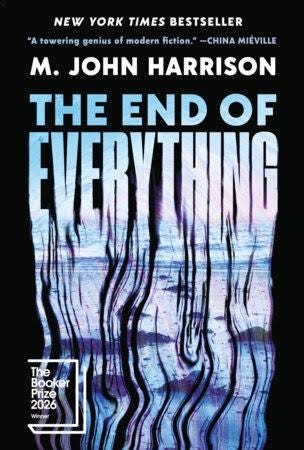
The End of Everything just won the Booker Prize, the first ever given to a writer who has logged decades in the mines of genre, both science fiction and weird fantasy. In Harrison’s hands genre has always been marked by irony and literary sophistication but, at the same time, works like his celebrated Kefahuchi Tract and Viriconium series still deliver the goods. The more “mainstream” novel The Course of the Heart is probably the most beautiful book of his I have read, a sad, retrospective post-occult novel that in a subtle way is his weirdest. I met Harrison once, an affable bloke with a grizzled but fit aging rocker vibe. When he won the prize I and mine cheered from the margins of the weirdosphere.
Weirdness certainly marks The End of Everything, with its salt-spray ambiance of dread but aimless implication. But what really hit me was the not-knowing. Early on, after starting awake in the middle of the night following some strange noise, Marnie reflects:
Had something come and gone, some blip, some glitch in things? Had something passed right through her, a whole lifetime or a universe, disguised as her neighbor, a bell and a fox? Since the crisis, everyone’s life was full of moments like these. It had been a long time since anyone could make sense of anything.
Harrison has often touched on existential themes, but he does so here by taking advantage of one of the core features of SF, a feature famously identified by the Marxist critic Darko Suvin as “cognitive estrangement.” Readers of SF, and edgier fantasy novels, know this feeling well. You begin a novel and don’t know where you are or how the world works, what rules govern society, technology, language, or even physics. Most of the time authors lead us through this estrangement relatively quickly, often through the use of info-dumps, so that we soon find ourselves in a world that seems real and generally comprehensible, or at least as real as fiction gets. In this way SF readers learn to trust or at least wager their initial confrontation with not knowing, and many — including some who left low-starred reviews of Harrison’s latest — become frustrated if that passageway is blocked.
But what if the SF author refuses to resolve cognitive estrangement? What if, while the fictional world remains superficially coherent — we aren’t reading Dada poetry — we are given little to no handholds? I am thinking here of a text like Hannu Rajaniemi’s wonderful The Quantum Thief (2010), a decidedly far-out but scientifically grounded yarn whose posthuman world of quantum entanglement, encryption, and time-bending currencies draws you into an extended and giddy mindfuck. Rajaniemi does not stop to explain much at all, especially in the initial chunk of the novel, which means that the only thing to rely on is the poetic exuberance of his prose, which unrolls like a flying carpet over an abyss of confusion. It’s fun.
Harrison himself did something similar in Light, the first and best book in his Kefahuchi Tract trilogy. As the critic Leigh Blackmore points out, the Kefahuchi Tract itself, a vortex of dark matter without an event horizon, “operates as a site of aporia, literally and metaphorically a site of Otherness and unresolvability.” That sounds pretty egghead, but its actually exhilarating, and almost definitionally weird. As we read we are led to ask: is this just a fiction, or is it some warp in things, or something happening right now to my own mind? Given Harrison’s stylist excellence, the smooth strangeness and concrete charm of his language, not-knowing becomes its own high. Even as Light provides some quantum explanations for the warp, the ambiguous prose throws us back on intuitions and nebulous feelings that normally get squashed as we get up to speed with a more conventional author’s world-building.
In The End of Everything, Harrison reduces the SF info dump to a few crumbs here or there, fragments that merge with the other flotsam and jetsam that follow in the wake of the iGhetti catastrophe, which itself remains, like Timothy Morton’s hyperobjects, or climate change today, impossible to limn. And here’s the magic, and the value. As we struggle to make sense of the objects, spaces, and social interactions we encounter — absurd fragments, iterative time loops, opaque social interactions — we slip into identification with the characters, not because of their resonant psychological depths or their charismatic appeal, but because we are now one with their befuddlement. All of us hear the same sucking sound between our toes as our capacity to model the (author’s) world gets drawn out to sea, leaving only confused alarms and ignorant armies clashing by night.
As with “the Jackpot,” William Gibson’s unforgettable name for the acute polycrisis that initiates the apocalypse depicted in his recent (and hopefully soon-to-be-completed) trilogy, Harrison gives us a powerful term of art we will not soon surpass: the “bad patch.” The phrase usually describes a difficult time in one’s life, but here the bad patch becomes an actual zone of space-time, a residue or ripple of the iGhetti that infects individuals or places with “unanchored events.” The term is a classic bit of English understatement, and, as Harrison suggests in the novel, a way to wrangle the derangement of the catastrophe by casting it in more familiar terms. As an example, we might refer to the recent paranoia-inducing clusterfuck of system breakdowns in the US as a classic “bad patch.”
The world of The End of Everything is singular and unforgettable, but it is not without precedent. Its bleak but almost topological absurdism recalls the cool psychic drifts of JG Ballard. But Harrison also reframes the mirthless grey of the novel into distinctly aesthetic forms shaped by painting, architecture, and assemblage — arts that stand in, as it were, for the extraordinary capacity of his prose to capture a vibe, a strange look, or a nexus of landscape or ruin. Far from redeeming the world or the soul, these aesthetically self-conscious moments suggest a situation where world-building and sense-making are restricted to the glowing and furtive fragment, the tang of empty light, and the feelings evoked through what Harrison himself calls a “moderate existentialism.”
The enigma of the iGhetti also recalls some old-school Soviet block SF. The beachcombers plucking their strange finds from an alien-inflected sea, along with the trade and manipulation of these artifacts, conjure up Tarkovsky’s portrayal of the Zone in Stalker, as well as the great novella that inspired the director, Arkady and Boris Strugatsky’s Roadside Picnic, whose enchanted objects may be nothing more than alien trash. Popular SF tends to positively portray the human encounter with the alien as a kind of interspecies communication — think of Star Trek: the Next Generation’s “Darmok and Jalad at Tanagra.” But the skeptics in the East intuited the incommensurability of it all. Here we cannot best Stanislaw Lem’s His Master’s Voice (1968/1983) in which a clearly constructed alien signal is subject to interminable analysis at a Pentagon project in the Nevada desert. While some interpretations are productive — strange objects are manufactured — in the end we are left with nothing but indeterminacy, the empty conjurings of a Rorschach blot.
The artifact that Phillip drags from the sea develops into a simulacral human who motivates much of the modest plot. The thing grows, learns, speaks, and eats voraciously. But rather than becoming a central node of contact with the iGhetti, a key to the mystery, the thing never loses its aura of jetsam — or is it flotsam? It — and it remains an “it” throughout — also provides a wonderfully oblique take on the banal and uncanny chatbots that now answer our questions, do our research, and increasingly manage our lives on and offscreen. The artifact here is an excellent mime, though for a while there is something malformed and lumpy about its hand (too many fingers, perhaps?). It acts sometimes as a font of useless information, a tourist guide, and a helpful if sometimes annoying servant whose motives remain opaque, if not nonexistent. But though it resembles a human being, there is nothing to be gained by conversing with it. The characters never pierce its mirror-like mask, or trust it to do anything more than mimic, like the alien simulacral sea in Lem’s Solaris. As Marnie recognizes, “it doesn’t seem […] as if an organism that emerged so recently from the sea can possibly be an authority on anything.”
The End of Everything marks, perhaps, a new and different stage to Lem’s problematic in His Master’s Voice and Solaris, one in which people mostly just stop trying to analyze, understand, and interpret the alien signal at all. Instead we drift through a world where, as in ours, many of the old rituals still survive in desultory form: seaside tourism, beachcombing adventures, casual violence, art. This doesn’t mean everyone gives up on investigation — one character experimentally tortures the human-like artifacts in order to access the “astral plane” that the iGhetti may have leaked out of, and his charred notebook provides some of the more philosophical passages in Harrison’s book. “The other world,” he claims, “doesn’t make any sense.” Its phenomena are open-ended and opaque. “Are they incompletely rendered? Or simply incomplete? Are they incompletely understood by us, or are they just not understandable in some absolute sense?”
Whoever has ears, let them hear. These are questions to sit with, not to resolve, but to refine, to craft, to drive to a point. At one point Marnie tries to explain to Phillip while she continues to paint despite it all. “Since the crisis became permanent, she had found it hard to concentrate on anything that made her feel as if the life she was living wasn’t hers.”
Most intimate.
I hope you enjoyed this flicker of Burning Shore. More than anything, I want to be read. If you would like to show support, the best thing is to subscribe and to forward my posts to friends or colleagues. You are also welcome to consider a paid subscription, and you can always drop an appreciation in my Tip Jar.
Excellent post Erik. Perfect timing too as I just finished a study group focused on the Fool and Hermit cards in the Marseille tarot. I’ll be picking up Harrison’s book once I finish Dan Simmons’ Hyperion Cantos (which I’m loving and not looking forward to leaving).
The Spirits of Mantis Hill and Limitless Poison Zendo approve of this message.