

One of the hats I wear is a California historian hat, probably best imagined as a turban with a fake jewel or a Mad Hatter jobbie, since my focus has been counterculture, drugs, and alternative spirituality. These concerns contribute one of the major threads of Burning Shore, which itself is named for a Grateful Dead tune about religious experience and the Golden State — two weird tastes that get weirder together, as I tried to show in my 2006 book The Visionary State: a Journey through California’s Spiritual Landscape.
That said, one of the purposes of history is to make weirdness a little less weird: there is a story behind everything, a story we can tell by weaving between archives, artifacts, architectures, narratives, theories, places. We understand things in part by contextualizing them, and history therefore serves the often disenchanting work of explaining why certain things are less surprising and more comprehensible than they might at first appear. That apparent flash in the pan has actually been bubbling away for some time.
California too may appear kooky and perverse on its surface, a kind of perpetual crack-up, the land of fruits and nuts — and, these days, AI safety cult transhumanists and technofeudalists galore. But the crucial question of the state’s outsize and often baleful influence on our world is answered in part through understanding those historical forces and cultural currents that anticipate and drive its surface appearances — forces of money and machines, metaphysics and the movement of peoples, that subtend the surfaces like the old Indian paths that trace the route of superhighways, or the shearing faults that mark the state’s extraordinary living landscape.
But history also serves a more ahistorical goal, at least some of the time, at least to me. This goal is to magnify the depth and resonance of our experience — an intensification rather than an explanation. That’s why the notion of resonance is important. Studying history, like reading literature and poetry, can tune the ear to the way that places and people and things always participate in a kind of rhyme or allusion or return of past time, sometimes as farce, sometimes as tragedy, occasionally as wonder.
History haunts, and to practice it the way I do is to invite ghosts into the room. Even the current antihistorical dogma of “disruption” has a deep, dark rhythm in this state, whose novel cultural experiments and technical interventions — often state-sponsored — may ultimately bubble up, psychogeographically speaking, from the grinding tension of its tectonic plates. Knowledge of the past, then, allows the topography of the present to chime. It offers a way to unpack tracks and traces that invoke forgotten ancestors and reveal, in the seeds and symptoms of later developments, a more poetic or even apocalyptic logic to the times, even or especially as those times grow wildly out of joint.
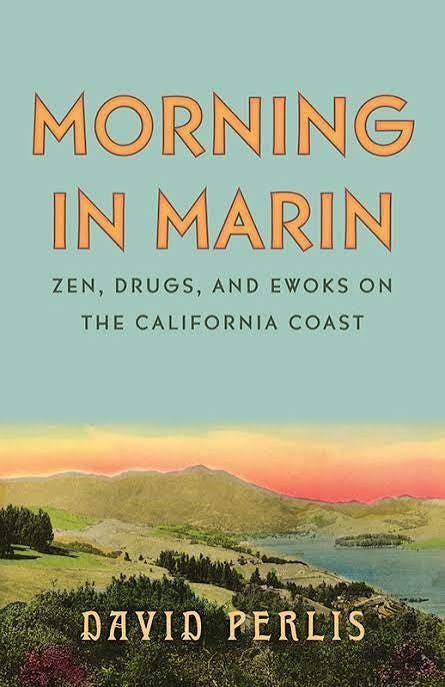
The psychogeographic mode is on fine display in David Perlis’ wonderful new book Morning in Marin: Zen, Drugs, and Ewoks on the California Coast. I have long held that Marin County is the weirdest county in the United States, at least when measured in light of its pervasive and somewhat invisible influences. As Perlis is at pains to argue, a lot of the countercultural power we associate with the Bay Area, or even with San Francisco, is more essentially traced to Marin, whose shrouded headlands and houseboat holdouts lie just north across the Golden Gate. In the Bay, Marin County plays something like the role that Laurel Canyon played in LA’s rock scene: a leafy and spendy enclave whose experiments in conviviality, consciousness culture, and hedonistic rock’n’roll shaped the nation. Though in Marin’s case, often in fogbound disguise.
That is why the central figure of the book is Druid Heights, where Perlis’ story begins and ends. You may have heard about this place by now, maybe even poked around its ruins, crumbling there on a flank of Mount Tamalpais not far from the hypertourist hotspot (and former Bohemian Grove watering hole) of Muir Woods. When I researched and wrote about Druid Heights over twenty years ago for The Visionary State, it was an open secret in the Bay Area underground, but one that still required serious digging to find the way and forge the outlines of the tale.
The “unintentional community” itself stretches back to the early 1950s, when everything seemed possible in California and when Elsa Gidlow, a lesbian poet from the East Coast, met Roger Somers, a bohemian carpenter who radically repurposed building materials and needed cash to purchase the land. Eventually the acreage became a community, a party zone, the birthplace for the first self-regulating Marin hot tub, and a retreat for Alan Watts and all manner of jazzbos and filmmakers and porn stars passing through the area. (More of my words on Druid Heights lie here, though I mangled the deets on Gidlow’s arrival in the county.) The title of Watts’ book Cloud-hidden, Whereabouts Unknown, which came out the year he died — of his excesses, and at Druid Heights — is an appropriately enigmatic invocation of the place.
First-time author Perlis does a great job with this story, as well as the fecund flowering of other Marin communities in the 50s, 60s, and 70s. These include the Sausalito houseboat scene, the poetic enclaves of Bolinas and Stinson Beach, and, on a more micro level, Anna Halprin’s workshops, trendy venues like the Trident and the Ark, and even Philip Dick’s burn-out way-station in Santa Venetia. As Perlis writes, “Trees fruit, Earth peoples, and Marin produces semicommunal spaces immersed in nature that challenge Old World mores.”
Perlis has done his homework and then some, weaving together a large sweep of places, events, and characters, but in a light and playful manner that keeps the reader engaged, provoked, and entertained. A textbook this is not. One of Perlis’ tricks is to weave a number of major themes and characters in and out of his vast tapestry, not just Druid Heights or Halprin’s dance scene, but Jean Varda’s houseboat, Gary Snyder’s “rucksack revolution,” the Grateful Dead, George Lucas, Joanne Kyger, Lew Welch, and Peter Coyote.
Far more important though is his jazzy style, which allows him to hop around and giddily celebrate complex lives with a sort of charmed fanboy grace. Popular histories generally focus on a few emblematic individuals whose stories are told more or less novelistically, but Perlis declaims his festival of hipsters, rockers, and mystics like a Beat poet narrating multiple soap operas at once. Tenses change on a dime, sentences are interrupted with stage directions, sober accounts peppered with fantastic digressions, as when Larkspur resident Janis Joplin decamps to LA to record some tracks in the late summer of 1970:
     One lonely night she shoots up, goes for cigarettes.
                  Chats with the night clerk.
                            Goes back upstairs, exits her body…
                                         Then rises up over the rooftops of LA, and drifts toward the   beach at Point Reyes, where she follows a path through the breakers to join Coyote. [...]
This kinda stuff can get cutesy, sure, but Perlis mostly keeps it under control. His exhaustive enthusiasm rarely gets exhausting, and his ability to play fast and loose with prose and to juggle the broken chunks of history charms the whole project, injecting an exuberant magic that seems watched over by Mount Tamaplais herself, the “Olympus of the Marinaissance.” While I found a number of minor errors, his lack of pedantry led to instant forgiveness, and they’re not worth mentioning.
Perlis’ joy in his material also allows him to deal in an interesting way with the dark side of the Force. Take Alan Watts, a thinker and writer I deeply love but whose behaviors, contradictions, and life decisions grow ranker the more attention you pay to them. This has led at least one biographer to excoriate the man as a selfish and indulgent bullshitter, a horny flim-flam drunk in a fake Zen robe. Perlis does not hide from the shadows here or elsewhere, but he does not allow them to drag down his telling, as is the wont of more resentful and earthbound historians and biographers. Here Watts comes off as a charming and brilliant mixed bag who, while he sometimes dressed like a guru, never claimed to be enlightened or even particularly moral.
Or take the matter of Coyote’s appearance in the Joplin riff above. Perlis is talking about the indigenous culture hero, of course, not the Digger Peter whose Marin exploits as a commune leader are told here with a warm feeling for their foolishness. But doesn’t the invocation of Coyote, who also appears in a mythic epigraph that opens the book, demand a reckoning with the bleak horror of settler-colonialism that faces all deep histories of California, where the genocidal slaughter was particularly great and the state fully complicit? But how to handle such a reckoning? Perlis is not about to let George Lucas get away with the travesty of the Ewoks in the subtitle — those teddy-bear product placements from The Return of the Jedi whose name garishly echoes the Miwoks who once called the peninsula home. That said, Perlis does not simply condemn or excoriate, which is such an easy way for authors to signal a moral stance. Instead, he tells a story about Jerry Garcia.
Though cemented to the mythology of the late 60s San Francisco, the Grateful Dead had already drunk deeply of Marin’s leafier delights when they landed at their famous home on 710 Ashbury in the fall of 1966. They had already enjoyed a high time at the Olompali estate and then at a former summer camp in Lagunitas, to say nothing of the Muir Beach site of one of the earliest Acid Tests, where they melted face as the house band. By the end of the decade, the band quit the Haight and moved more or less en masse to various houses and ranches in Marin, a scene change that became an influence — or “Marinspiration” — that Perlis rightly ties to the sepia-toned saddle scruff of Workingman’s Dead.
Years before, high on acid at Olompali, the guitarist placed his fingers on a material trace of the county’s past: the remnants of an earlier adobe building kept visible through a small window in the hall of the palatial estate. Rock Scully reports then finding Garcia shivering under a table, freaked out by the enormity of the Spanish presence in California and the horrible near destruction of the natives. This is how psychogeography works: Garcia, whose father was from Spain, had encountered the ghosts of stone, and found them already present in his own mind.
Morning in Marin triumphs as its own sort of ghost dance for the county’s OG underground. But, for me, it somewhat loses its way in the late 70s and 80s. A bifurcation point here is The Serial, Cyra McFadden’s popular satire of affluent Me Generation indulgences in Marin, which appeared in the late 1970s and was later made into a movie with Martin Mull. While the old-school locals at the center of Perlis’ story mocked or resented or ignored The Serial as unreflective of the real Marin, the reality is that it reflected the Marin that came to matter more than Varda’s houseboat parties. While Marin had always been comparatively expensive, The Serial pointed to a new and deeply significant mutation in American wealth culture: the absolute fusion of liberal affluence and post-hippie self-help indulgence, a fusion that became mainstream, and arguably the dominant tone, in Marin before anywhere else.
This is the mutation represented by the human potential movement, by est, by open marriages (and frequent divorces), by pop tantra, by casual drug use, and by the sort of quasi-spiritual health regimens that have now flowered into a multi-billion dollar industry. For a predictably unforgiving portrait of all this, check out the NBC documentary I Want It All Now! from 1978.
Marin is extraordinary, but it is also the wellspring of yuppie wellness. This emergence is largely missing from Perlis’ book, which, though it mentions The Serial and a bit of self-help culture, prefers to direct its later discussions to rock’n’roll hold-outs and the awkward, rather soulless career of George Lucas. Similarly, Perlis only gives a paragraph or two to Iasos, the extraordinary and pioneering New Age musician who, along with the spectral Rhodes mystic Steven Halpern, who is barely mentioned, lived and recorded in Marin, channeling its healing energies into sound. But instead we get many pages on Huey Lewis and the News.
My disappointment here is a matter of taste, but it is also a matter of centering particularly California currents, especially trends in technology and the New Age writ large. Iasos’ turn to the home studio, angelic dolphin imagery, and the new distribution network of the cassette tape echoes a far more significant technological mutation that would take place near the end of Perlis’ tale in Sausalito: the 1985 creation of The Well, the Whole Earth ‘Lectronic Link, the first major virtual community online (and one that, moreover, seethed with Deadheads). Though he cites Stewart Brand here or there, Perlis ignores this major development in Northern California communalism, along with significant “new paradigm” institutions like the Institute of Noetic Sciences or the earliest stirrings of Spirit Rock.
Don’t get me wrong: Morning in Marin is a great book of counterculture Californiana, and you should buy it and read it if you like that kind of stuff. He has definitively and sympathetically mapped postwar Marin’s unique blend of collective experiments, nature mysticism, Buddhism, rural (or at least suburban) counterculture, and healing vibes. He just jigged when I would have jagged.
Luckily, any hankering I might felt for the deep New Age has been more than made up for recently by Jacob Smith’s new history of the movement, Bridge to an Unseen Shore: New Age Music as Visionary Art. As I reported last month, I dug the book so much that I hooked Jake up with the Gray Area in San Francisco, which in turn hosted a weekend symposium a few weeks ago. The wonderful if somewhat sparsely attended event, which saw a number of grey-haired New Age heroes in the audience as well as on the stage, included performances, film screenings, and onstage discussions, including my interview with the voluble Steven Halpern. I earned personal nerd points when he said that I was the first interviewer ever to ask him about the explicit quotation of Miles Davis’ “In a Silent Way” that opens the “Keynote E” track of his legendary Spectrum Suite. Ding!
I got to chat with Kat Epple of the great Emerald Web, and also with the legendary, to me, Larkin, a flutist whose O’cean (1980) remains one of my all-time favorite New Age recordings. The first side, “Emergence,” brings together three signature vibes and symbolic registers of the movement: Larkin’s ancient woodsy flute; minimalist cosmic tones coaxed by Michael Stearn from the Mighty Serge modular synthesizer; and some humpback whales courtesy of Roger Payne.
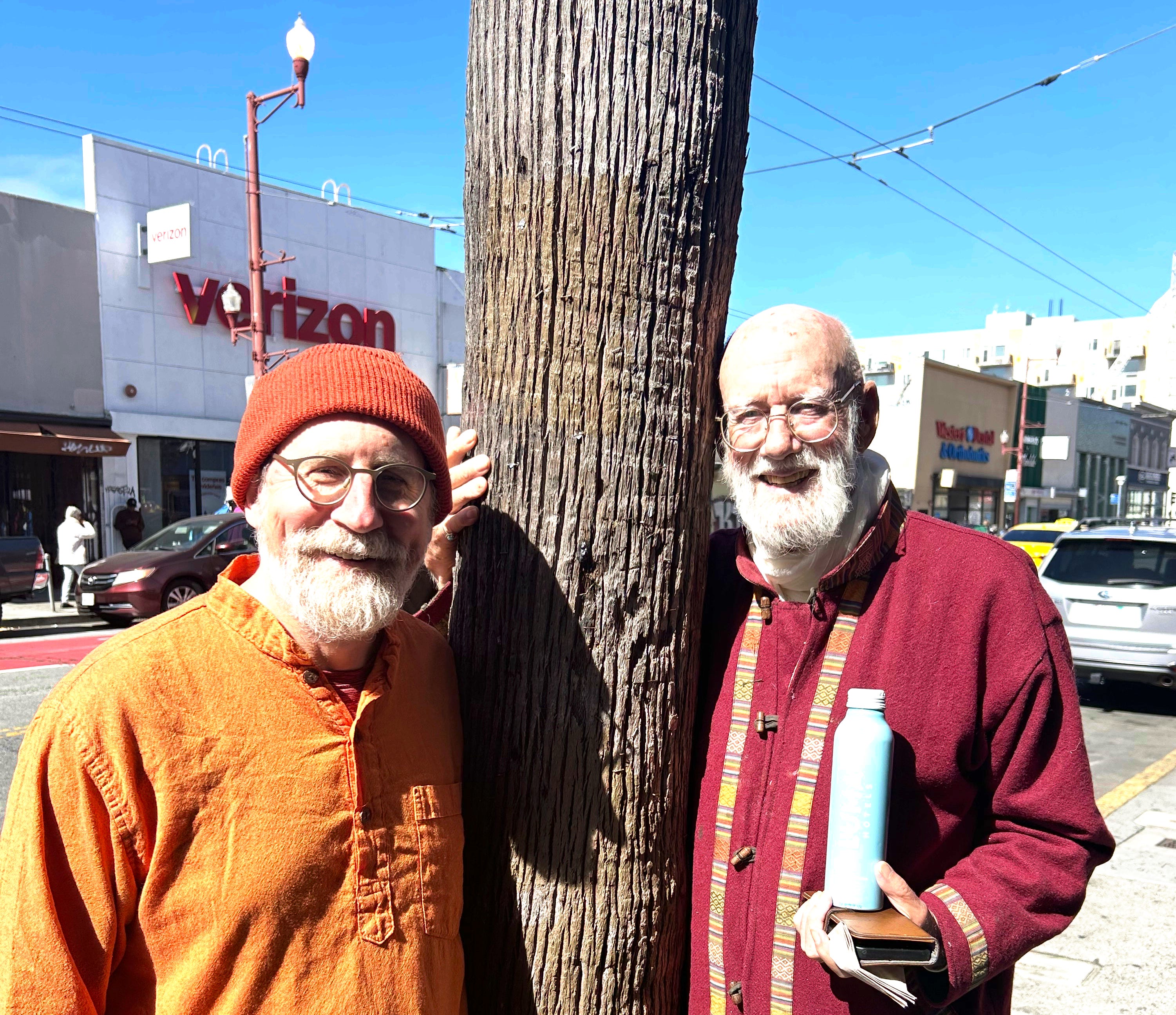
I never grokked the photo of the back of O’cean though, which shows Larkin directing his flute sounds towards a young woman drifting in a sort of beatific trance. The answer for all this was provided by Smith, who worked like a New Age gumshoe for his book, tracking down seemingly everyone who was anyone back in the day. While Smith began with a focus on New Age music, his research eventually crystallized – sorry – into the core argument of the book, which is that New Age was an aesthetic and spiritual movement that worked with multiple genres and modes of human expression. And one of those modes was somatic movement, particularly in LA’s Continuum scene, which grew up around the dancer Emilie Conrad. Conrad was a wild woman, had spent time in Haiti, and crafted a subtle and profound “anthropotechnics” that continues to be practiced today. The woman on the album cover was, it turned out, Susan Harper, a major Continuum teacher (and wife of Stearns, another Continuum composer) whose spontaneous meditative movements inspired Larkin’s improvised tones on O’cean’s side two track “Communitizing.” One of the highlights of the Gray Area event was the demonstration of Continuum movements by Georgianne Cowan, in somatic dialogue with Larkin’s dulcet tones.
Bridge to an Unseen Shore is a more conventional scholarly history than Perlis’ Marin book. Smith is a professor after all, and in clear and confident prose, he lays out his argument about a “visionary art movement,” maps and articulates various dimensions of the scene, crafts compelling portraits, criticizes contradictions, and traces historical developments, relationships, and signature works. What sets his wonderful book apart from other accounts of New Age, at least in cultural studies I have seen, is his deep sympathy for the spiritual aspirations of the movement and its makers.
Other scholars, offering broader treatments of ambient or psychedelic music, tend to give classic New Age the same sort of flak the treacle they play in health spas deserves. But it’s crucial to divide the first decade of the movement from its later corporate assimilation in the mid-1980s: whatever else they were, artists like Iasos, Stearns, Deuter, Steve Roach, Laraaji, Halpern, Emerald Web, Peter Davison, Jordan De La Sierra, and Georgia Kelly (who almost made the event) started out as far-outsiders. As Smith argued from stage, the DIY drive of this movement — in which independent artists controlled recording and production, and distributed their essentially ecstatic music through subcultural channels — make it more like punk than you’d first think.
It is the simplest game of connect the dots to argue, as many do, that the cosmic optimism of New Age is nothing but a bandaid for capitalism, or a naive and anodyne portal to the later excesses of wellness culture. But as Smith argues, “Critiques of comforting, healing music can discount the real needs of listeners in maintaining health and resilience in a chaotic world.” Given the shitstorm at our gates, which well may grow to hurricane strength in the months ahead, health and resilience are survival values. I listen to OG New Age in part out of an escapist pleasure in analog fantasy, for sure, but I also draw sustenance from its spiritual generosity and goodwill. I also believe it is one of the best soundtracks for dissolving, not just tension or anxiety, but the boundaries of personality. It is one of the great musics of cosmic porosity, of letting go into the all of it.
This suggests another real need this music satisfied and still satisfies, both in retrospect and as an ongoing inspiration to musicians plying these astral waters: the value of crafting a positive vision of planetary transformation, however fantastic, however unlikely at this late date. “New Age music, like other embodiments of visionary art, explores the art and politics of the future,” Smith concludes. “It is an incubator or alchemical retort for vital new mixtures and energies, rarely the end of the story in terms of social and political life but often the fertile start, the spark of a new life.” I am not sure we can live without enjoying gauzy flickers of this kind of light, however dark things have become.
One contemporary manifestation of the New Age sensibility is Gaia TV, an online source of films, docs, yoga classes, and meditation programs. “Expand Your Mind,” it promises. “Transform Your Life.” I remember stumbling across Gaia years ago, and was surprised to find out that it’s still holding on, maybe even thriving given how mainstream and profitable all this crazy shit has become. Here you will find media on pop gnosticism, UFO disclosure, ancient aliens, mindfulness, sun salutes, “frequency tuning” meditations, Big Pharma evils. This is what, in the wake of QAnon, New Age has become. Not always helpful, rarely true, but still IMO part of a complete balanced media breakfast.
I don’t track this stuff with anything like the fascination I once did. I found my way to Gaia this time for one reason only: to see Greg Mallozzi’s hour-long documentary The Ether Ship. Greg reached out a year or so ago about a newer film he is now just completing, a fascinating feature-length investigation of the paranormal researcher-cum-intelligence asset Andrija Puharich, who left his swirly fingerprints all over PSI topics like magic mushrooms, Uri Geller, telepathic kids, and the notorious higher intelligence posse “the Nine.” A week ago, a Burning Shore reader suggested I check out Greg’s earlier film.
The more I know about and enjoy the spiritual, psychedelic, and weirdo currents of the 1960s and 70s, the less surprising every additional discovery tends to be. I tallied up a number of novelties in Perlis and Smith, and only a few popped my eyeballs out of my skull. But once in a while I stumble across singularities that still blow my mind, that seem like cleverly symbolic fictional inventions, or anomalies on par with paranormal ruptures of the laws of physics.
Such an anomaly is the visionary musician Willard Van De Bogart, who launched an experimental “ether ship” collective in the early 1970s from a storefront on the Haight. Van De Bogart and his fellow players were not just psychedelic hippies but avant-garde musicians who explicitly aligned their far-out sounds with extraterrestrial and higher intelligences. This is hardcore New Age. As the Gaia description has it, “Van De Bogart’s pioneering compositions explored whether frequency itself could serve as a portal, mirroring theories of multidimensional propulsion and the elusive flight mechanics attributed to an etheric craft or high-altitude etheric spacecraft.”
Since the core of the story lies in the 70s, an era of electronic paranoia, tales of intelligence agencies and UFO contact programs inevitably enter the story. Mallozzi’s account of De Bogart’s electronic musical vision, based on interviews he made just before the composer died, is also tied to childhood experiences of entity encounter. I have been paying attention to UFOs for too long to believe in much — and certainly not in the value of calling them “UAP”s. But I do believe that people like De Bogart “have” these experiences, pretty much like they describe them, and whatever their basis. But what has become more interesting to me is what happens when creative contactees make visionary art from these anomalous encounters. The New Age pioneer Iasos channeled his “paradise music” from Vista, the Elohim of the Fifth Ray. De Bogart was also aiming towards higher intelligences, but more in the Close Encounters mode of contact and communication.
The Ether Ship is simply extraordinary, and well worth watching. As the Gaia description promises, the film invites you to “Discover how modular synthesizer experimentation converged with ancient spiritual philosophies to decode mysterious acoustic phenomena.” What more could you want?
Mallozzi has mastered the art of compiling and collaging rare archival materials, and he weaves in a number of far-out interviews, which include substantial chats with De Bogart, Jacques Vallée, and the utterly fascinating and untrustworthy New Age dandy Dr. J.J. Hurtak. But the filmmaker’s real skill is to channel his well-crafted historical narrative directly from the excluded middle — that liminal zone between and within belief and skepticism, love and fear, yes and no, hope and paranoia. Given the ontological barbarians at our gates, it may wind up being the only game in town. Gaia offers a free trial, so you can always watch the film and then get out of Dodge before the Greys get their spindly fingers into your pocketbook.
UPCOMING EVENTS
• Day of Death
Halloween is always a special time around the Berkeley Alembic. On Friday October 30th, meditation mastermind Michael Taft will once again be leading Death Sangha, a guided meditation through the infernal bardos of Thanatos that will no doubt sell out. The next afternoon, we are doing something new. The Day of Death: Facing Mortality, Mourning, and the Strife of Endings, hosted by Chalice honcho and de facto death doula Maria Mangini, will feature three afternoon talks that address a few of the many faces of death, the single most interesting and important topic nobody ever talks about.
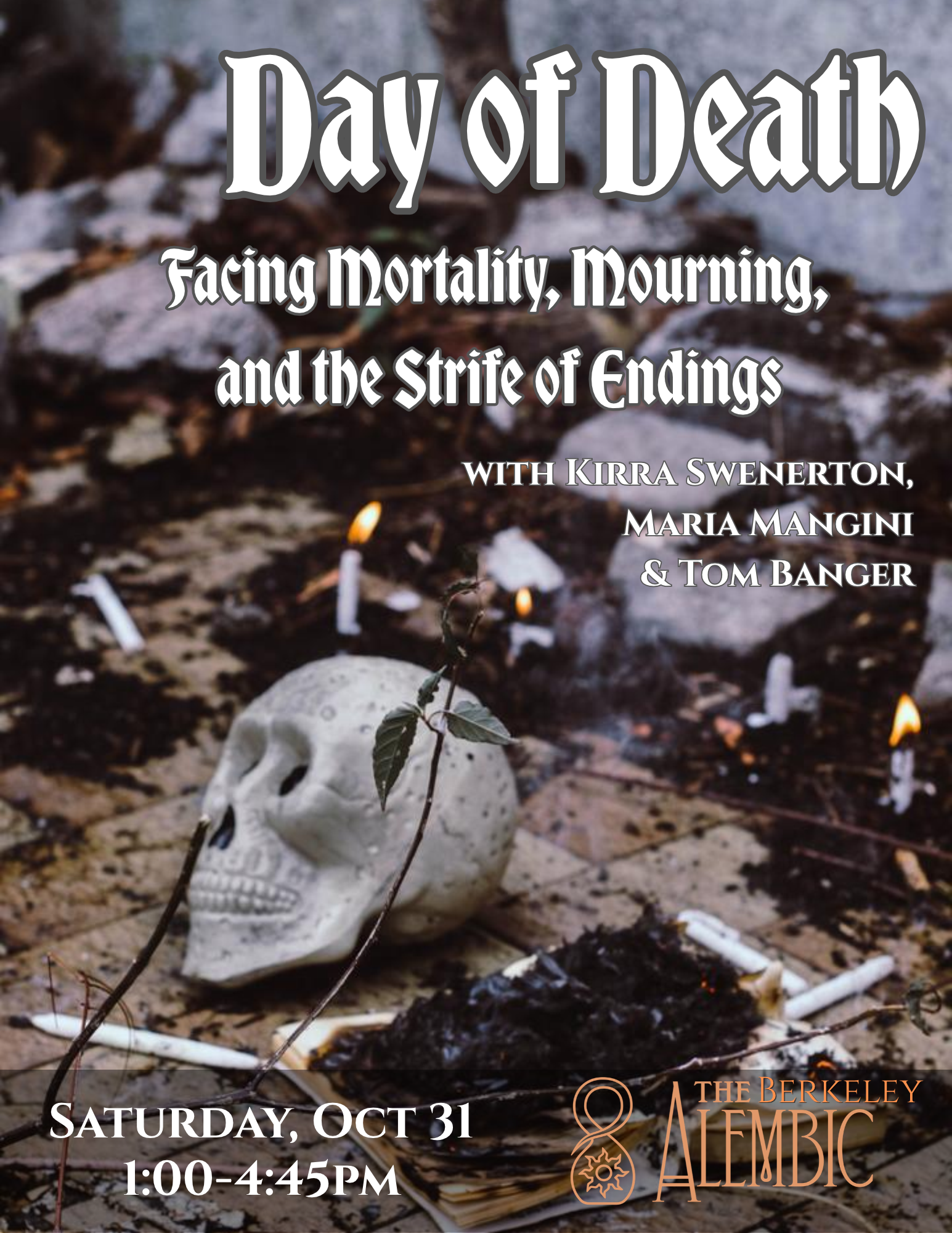
Maria will present on “Mourning Dress: Making Grief Visible,” an illustrated lecture that traces the visible language of bereavement from the Middle Ages to the present. In her talk “Facing the Wave,” the ecologist and healer Kirra Swenerton will invite plants, butterflies, dreams, and gurus in to help with the heavy work of transforming ecological grief into an act of reverence. Finally the Alembic is honored to host the incredible Tom Banger, who did deep work in the transgressive magickal underground of the 1980s and 90s before he wound up working in cybersecurity for the DHS (!). In 2023, Tom was diagnosed with glioblastoma multiforme — the same brain cancer that took Terence McKenna — and he began developing what he calls gliomancy: a syncretic mashup of mysticism, shamanism, Stoicism, Shinto, Zen, pop psychology, and the Kübler-Ross grief model. Tom is a pioneer in a frontier we all must visit.
• Joyful Noises
My old pal Spiros Antonopoulos has been DJing and doing radio off and on for decades. Recently he has once again taken up a slot at True Taos Radio (KNCE 93.5 FM). Another veteran of the analog transgressive underground, Spiros is also a life-long yogi, a chai wallah, a magical adept, a nutball, a sweetheart, and a deep student of Jyotish, South Asia’s rich and complex system of astrology. His radio show Joyful Noises, which reflects all these facets of his being, is broadcast every new and full moon, which means a new episode will be dropping any moment now on his Mixcloud.
Spiros will inevitably rap a bit about nakshakras and lunar transits, but do not fear: the soul-bending sonic curation is why you show up. Spiros has a unique take on the art of musical juxtaposition, as the tracks move, somehow elegantly, between soothing and aggressive, mystical and bizarro, ominous and ridiculous. I rarely recognize anything, and am often moved, at least to smile. Hindu bhajans and chants are woven through most episodes but they find themselves melting into other currents: classic avant-garde, weird noise, aching electronica. “Is he serious?” you may ask yourself at times, though that is the wrong question to ask. The right question has no answers.
• Forbidden Knowledge: Introduction to Esotericism
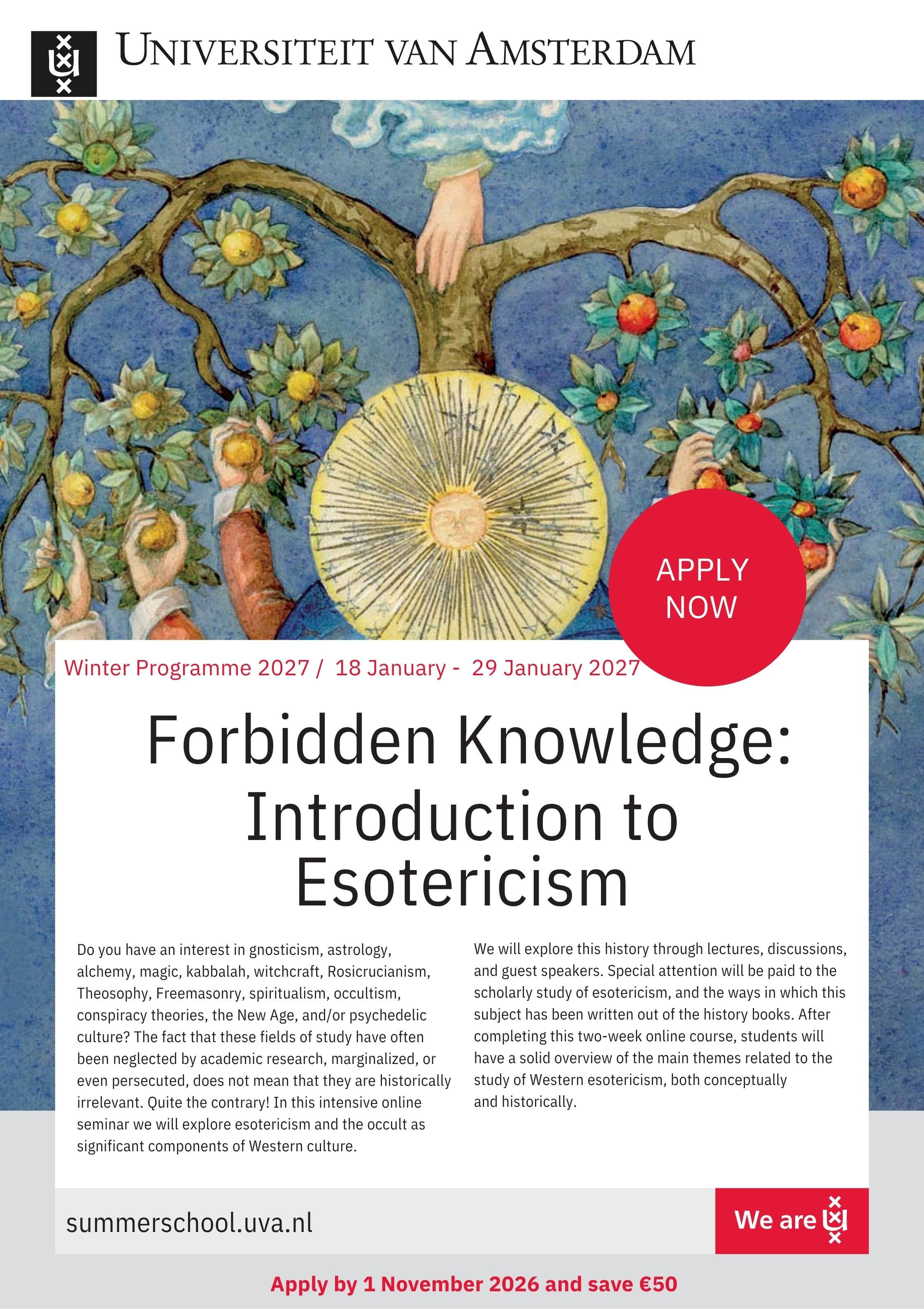
Hear ye, hear ye: my man Christian Greer, a secret freak successfully working the academic game, will be leading an online two-week intensive in the esoteric tradition this January. It’s called Forbidden Knowledge. As regulars to the Chalice know, Christian is a great teacher — animated, incisive, goofy, and endlessly thought-provoking. He got his PhD from the University of Amsterdam under the great scholar of esotericism Wouter Hanegraaff, and he also teaches The Psychedelic Universe, a two-week in-person intensive in global psychedelic culture every summer in Amsterdam. Definitely worth a plunge into the mystery.
I hope you enjoyed this flicker of Burning Shore. More than anything, I want to be read. If you would like to show support, the best thing is to subscribe and to forward my posts to friends or colleagues. You are also welcome to consider a paid subscription, and you can always drop an appreciation in my Tip Jar.