

You have probably had enough Odyssey talk by now, but here’s another take, now as cold as a fish. Still, I just can’t pass up the opportunity to reflect on one of the great myths of the sea, that briny zone of thought and experience that has pulled me under ever since I reread Moby-Dick late last year. Considering the fact that Nolan’s film became that rare Hollywood thing — an actual event — it seems hardly accidental that the story centers the centerless sea, its island varieties, its dark moods and hazy enchantments. So let us drift.
For Adorno, the Odyssey is the myth that overcomes myth. Ulysses enacts the modern alienated calculating self, the spirit of Enlightenment, wresting itself out of the primeval mindmeld of ancient time represented by the monsters and challenges Ulysses encounters on his voyage home. Our hero’s main struggle of course is with Poseidon, and therefore with the sea itself. Thinking with Adorno here (and Jung), the sea in the Odyssey represents Myth itself, the great immersive and claustrophobic realm of the archaic or collective consciousness, which is always seeking to draw us back in, like a Siren or a pharmakon.
Yet at the very same time, the sea is the global chessboard of the modern West, whose colonialist engines were fueled with Enlightenment and rationalist values. The strange Russian nationalist Aleksandr Dugin argues that the West is an “Atlantic” civilization, one whose development along coastal geographies shapes our cosmopolitan culture, both mercantile and maritime. Aren’t we the ultimate “People of the Sea” we hear about in Nolan’s film, pouncing on new shores from beyond the blue horizon? And doesn’t it seem that we are all terribly adrift now, swamped and sinking, ourselves — and modernity, and democracy, and reason itself — all at sea?
This makes the questions of monsters all the more pressing. How did Nolan fare here? Ulysses earns Poseidon’s wrath because he blinds Polyphemus, whose appearance is one of the peaks of the flick — a high point achieved partly through the down-to-earth. As Ulysses approaches the cave of the Cyclops, Nolan gives us the strongest and meatiest single shot in the whole film: Odysseus clambering up the rocky path after a few goats, a wordless and patient shot that, at sixteen seconds or so, is about as close as Hollywood gets to slow cinema.
Let’s be clear. Nolan’s preference for old school physical effects over CG(A)I is nontrivial in an epic blockbuster in 2026, a global testament of analog values in a summer of AI acceleration. Though his vision of the Mediterranean is not nearly as brassy and blue as it should be, his big old camera constructs a physical place, not like the digital deliria that dominated the Spiderman preview they fed us before The Odyssey. So too is Polyphemus himself largely a material delight — an enormous puppet brought to life by the meta-clown moves of Bill Irwin, and topped with a single but naturalistic eye whose unsettling vertical skew strikes a true note of Wyrd.
But is Polyphemus a sea monster? No, whatever his parentage. Like the ocean-front terror Scylla, another contender, he lives in a cave on land. But Nolan does resolve the Cyclops encounter at the shore, a location that is repeated almost immediately in the subsequent rout by the Laestrygonian giants — a sequence that, as Chris Norris argues, cannot help but recall the great battle cry from Monty Python and the Holy Grail: “Run away! Run away!”
That’s the thing about our agon with the sea: it often takes place on land. Nolan himself can’t escape the littoral zone. In Troy, the Greeks spend a decade as beach bums, before Ulysses leaves the treacherous horse in the surf. Nolan locates Hades just beyond some long tidal flats (in the poem it’s by the freshwater river Oceanus). And Odysseus later spends a lot of his time with Calypso moping by shore. The Sirens too are creatures of land’s end, wan and unimpressive as they are here, their uncharacteristically agonizing song a reminder that Nolan’s grim and sexless Ulysses has no taste for the yums. It’s all work and struggle for our modern boy.
But what about the open ocean in Nolan’s film, the swells that suckle the dread “People of the Sea,” the watery maw that swallows up that hazy setting sun we see? Given the absence of Poseidon as a visible character, or any boat-crunching leviathans lurching from below, the ocean itself carries the Mythic depth charge in Nolan’s Odyssey. Charybdis, here, is a “monstrous whirlpool” rather than an actual monster. Sadly, there is something tepid about Charybdis, for all its realism, more of a toilet bowl than a maelstrom. And while much has been made of the open-ocean shooting conditions behind the storm sequence, with actors puking as they got soaked with actual spay, I found the scene lackluster, and for one specific technical reason. Nolan anchored the cameras to the longboat, which means the film’s POV unwaveringly retains the level stability of the boat vis-à-vis the roiling rollercoaster disorientation of the sea. Besides diminishing our own participation in the wooze, this decision retains agency with the humans rather than giving it over to the ocean.
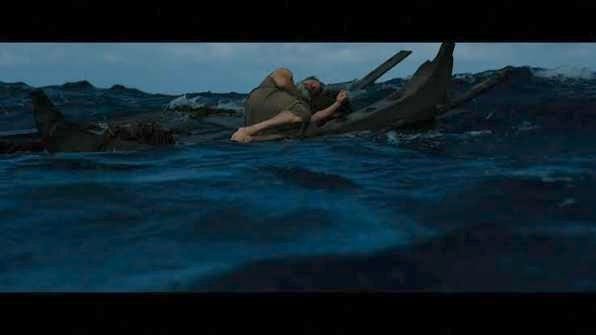
Which is why the most powerful oceanic sequence in the film is Ulysses’ lonely trip on the crappy raft that takes him away from Calypso. The nymph, knowing that Ulysses has grown restless, reminds him that while Poseidon really wants to kick his ass, Zeus won’t let his brother actually kill the hero. (This is the only time in the film that we glimpse the strife between the gods that forms the supernatural backbone of Homer’s poem.) So basically she encourages Ulysses to take his medicine. His submission to the waters has a curious Christian tinge here — he accepts punishment for his sins, a notion utterly foreign to Homer’s hero. But I am deeply compelled by the image of Ulysses lying prone on his primitive raft as he submits to Poseidon’s wrath. Visually, he is basically lying down on the water, surrendered to its chop and churn, with even the smallest waves threatening to choke or drown him, utterly at sea.
Weirdly, a similar image floated through another recent, very different film. The Love That Remains (2025) was written and directed by the fine Icelandic filmmaker Hlynur Pálmason, who also made the peculiar and gorgeous missionary movie Godland. His latest film is a different creature, lighter in tone but somehow more substantial, a comedic drama about an Icelandic family suspended in an awkward and frustrating bardo between togetherness and divorce. Pálmason prefers the vignette or situational slice to narrative, which means there’s not much Big Myth going on here as the months drift past. At the same time, he rejects the sobriety of straight realism, and sprinkles in off-hand spells of its more magical cousin. The film’s central recurring image is a mannequin tied to a post outside and topped with a knight’s helmet, a figure we watch transform through the seasons as the children pepper it with arrows. Towards the end of the movie, the figure stands up and starts stumbling around.
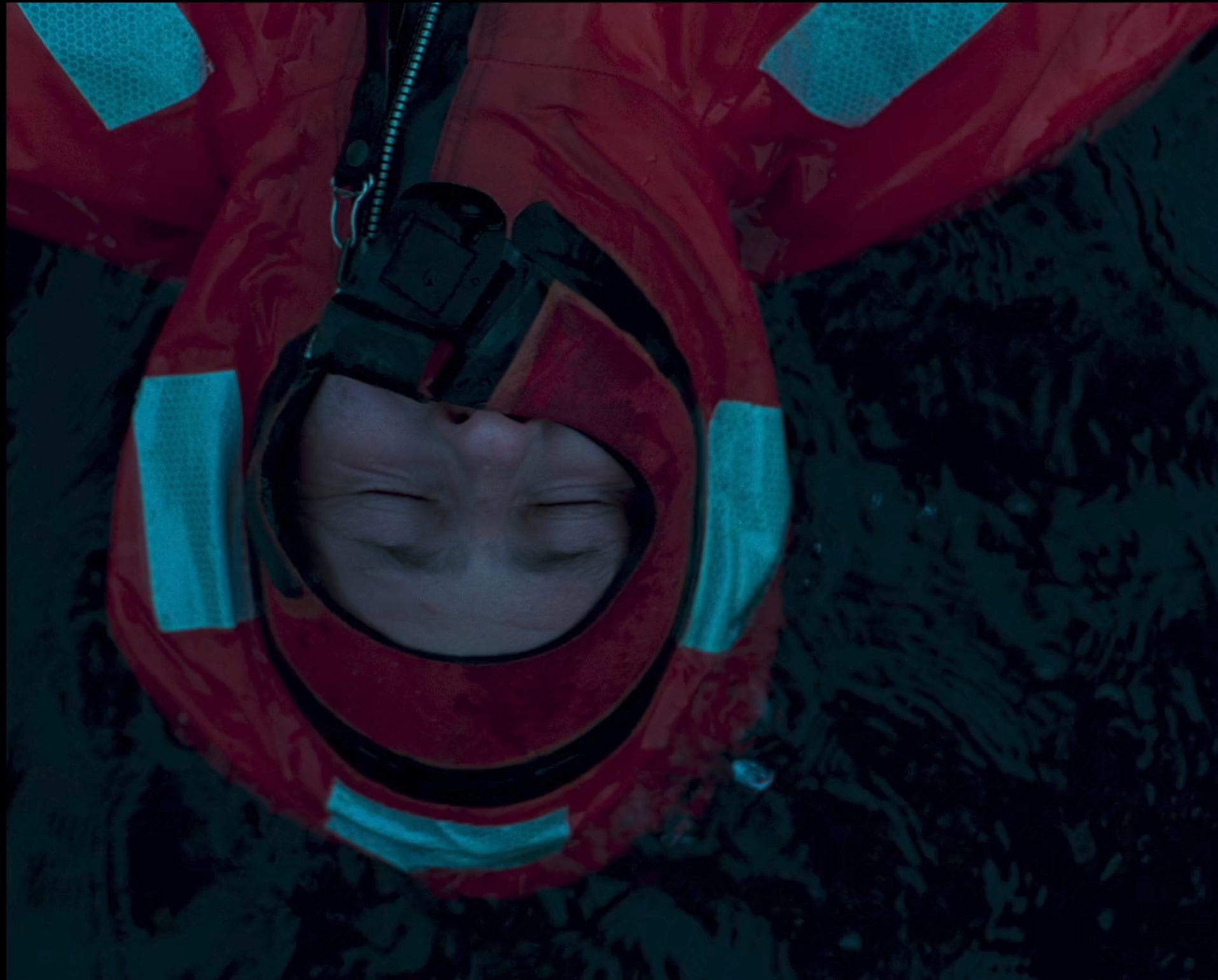
Throughout the film we watch the rejected husband Magnús struggling to understand what’s happening to him, how to be a father to his children, how to maybe fuck his wife again. He keeps leaving to go work on a commercial fishing boat, whose grueling weirdness Pálmason captures with the awed and awkward respect that marks most of us who pay attention to the lives of professional fishermen. Magnús is on the ship when news arrives that one of his sons has been shot with an arrow. To get him ashore, the crew set him loose in a cherry-red floating immersion suit with the promise that another ship will pick him up in a few minutes. (These “lobster suits” are a real safety feature of northern fisheries.)
As he lies there, floating in limbo, the minutes, of course, become hours. For a moment, though, it looks to us like a strange encounter is in store. From underwater, the camera first shows Magnús floating above. Then we cut to a barnacle-encrusted bowhead whale swimming in deep waters. But rather than the expected shot/reverse shot, the next cut takes us away from Magnús to an LCD screen showing a David Attenborough documentary about northern whales. Magnús’ potential encounter with Leviathan melts into nothing. He is alone. He cranes his neck to look for the next ship but then gives up, lies his head back, and screams the way we all want to scream now, in frustration, and dread, and absurd testament. Darkness comes, and the credits roll. The sun has been swallowed whole.
FISHERS OF MONSTERS
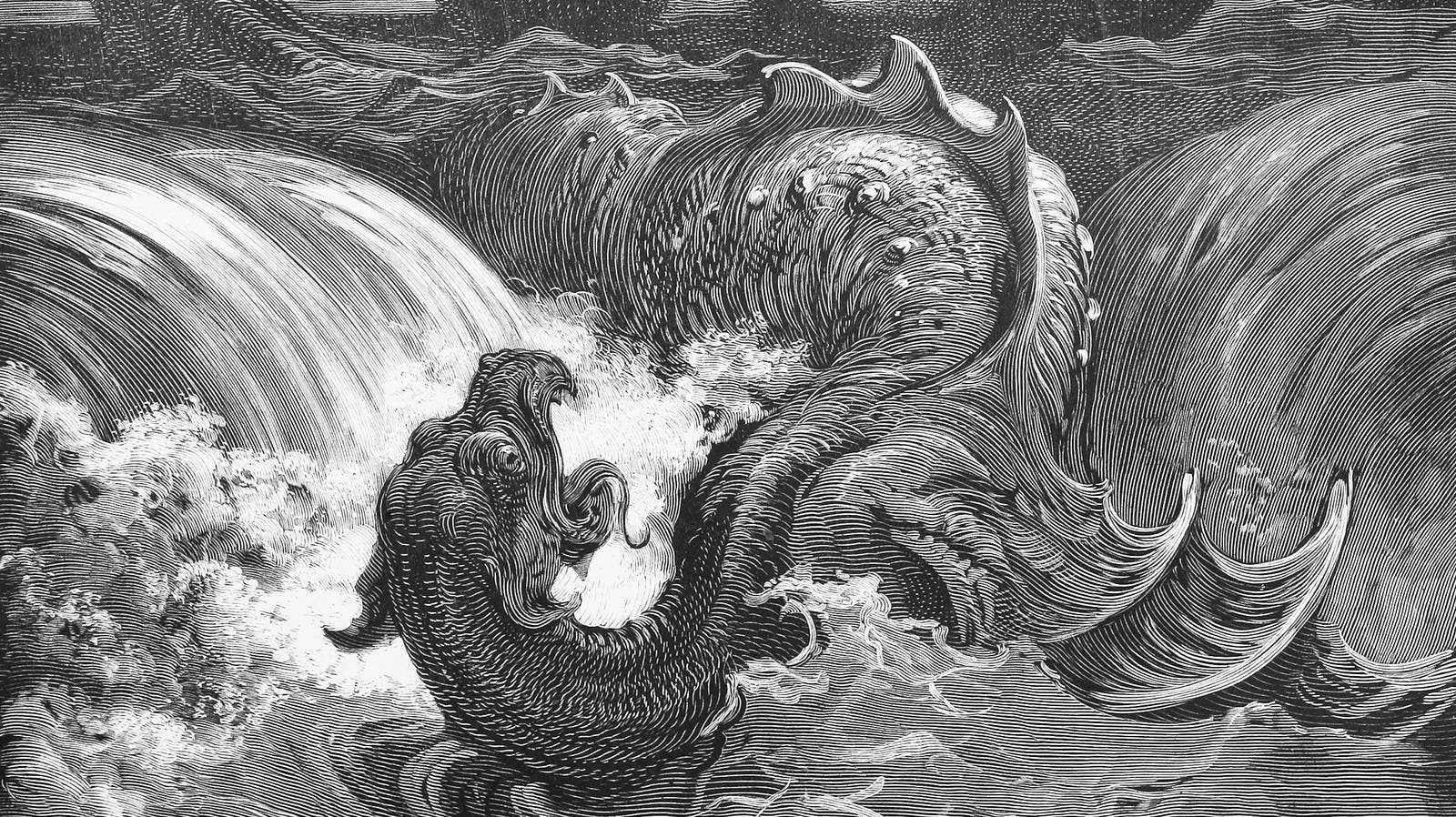
The Greeks had a lot of cool sea monsters, but it took an older Near Eastern imagination to craft Leviathan. Taking form variously as a serpent, a whale, or a fantastic behemoth of the deep, Leviathan’s original form depends precisely on its lack of one — a formless bornless one, a chaos to tempt heroes and culture crafters alike. First bubbling up from the depths of ancient Mesopotamian and Canaanite cosmology, Leviathan lurks as well in the watery void that moves old Jehovah in Genesis 1. Indeed, if the Hebrew Bible has a boss monster, it is Leviathan, not Satan. In the Extracts that open Moby-Dick — still the most capacious modern vehicle for Leviathan’s mythopoetic and material bulk — Melville’s “sub-sub-librarian” begins his catalog of quotations with Genesis — “And God created great whales” — and then moves from Job to Jonah to Isaiah and his prophetic “dragon that is in the sea.”
Moby-Dick hangs like a heavy thunderhead over John Langan’s The Fisherman, a cosmic horror novel that came out a decade ago but that I just got around to reading. Actually I listened to it, and one of the meditations this thoughtful and disturbing novel occasioned was whether or not the audiobook heightened or lessened the chills. The novel consists of a long first-person narration by Abe, a widower who, after forced early retirement, starts to fish recreationally in the mountains and streams of upstate New York. Following the ways of grief and friendship and cursed psychogeography, he is led ineluctably into the creepy deep.
I don’t want to say too much about the story itself, which you should read if you like this kind of thing. Langan has carefully constructed a work of cosmic horror that operates in today’s terms. He serves up sub-sub-genre demands like mind-bending occult tomes, degenerate human stock, perverse histories, and invasive otherworlds. But he grounds these banes in everyday prose and contemporary sensibilities. He also builds relevance by beginning the story with the death of Abe’s new wife, an all-too-human confrontation with mortality and deep grief that, though horrible, is in no ways mysterious. Abe’s fishing buddy undergoes a more traumatic version of the same fate, and grieves to the point of mental collapse before taking up fishing with the older man. As Langan knows, the gut-wrenching voids of grief ultimately pay the bill for the existential dread that infuses cosmic horror. With care, Langan skewers our own squirming fears on his hook before he tosses the line into the inky deep.
What interests me here is how deep those waters go. For while streams and creeks and reservoirs form the watery settings of The Fisherman, which draws in the folklore and fish tales of landlocked mountains, Langan ultimately cannot keep the sea, nor Leviathan, away from his story. But to discover what awaits Abe on those dark shores, you will have to swallow the tale yourself.
Here’s the question then, as it so often is these days: audiobook or not? After all, there are many differences between reading and listening to a story. When the story is a first-person narrative like The Fisherman, the audio reader is really an actor performing a solo radio play before an audience of one. But reading first-person tales, especially stories of madness and loss, can actually merge our personal “I”s with the “I” on the page, looping us more deeply into the flow of feelings coursing through the narrative.
On the audiobook for The Fisherman, Danny Campbell captured Abe’s folksy, down-to-earth intelligence very well. But Campbell’s overly measured tones took the edge off the more outlandish and macabre scenes, rendering them too matter-of-fact to be properly convulsive. For comparison’s sake I listened to Basil Rathbone read some Edgar Allen Poe stories. A paragon of elegant diction, Rathbone remains in total control, but he also knows when to lose it, or feign losing it. The propulsive mania and shattering anxieties he unleashed at the climax of the “Tell-Tale Heart” stood in stark contrast to Campbell’s nonplussed narration of events that would cause most of us to lose our marbles. Campbell misses the essential logic so brilliantly captured in the game mechanics of Call of Cthulhu: the more you know about the mysteries, the more insane you inevitably grow.
I find that listening to fictions catalyzes a more passive listener within me, a receptivity that in my case triggers more visual images. There is something almost childlike about this state, which is why I tend to listen to boldly told and often fantastic stories — sword and sorcery, world myth, epic poetry, adventure stories, horror. The last two times I read the Odyssey, for example, I mostly listened to it. A text in hand always presents a reader like me with tangle of possibilities, a puzzle to pick apart if not read over, and I reserve this mode these days for thornier and more complex fictions. I would not have enjoyed Audible’s version, if it exists, of The Man Without Qualities. With audiobooks I prioritize immersion in a story, and full submission to its undertow of image and incident. Just lie back on that raft and go with the flow.
Such submission is appropriate for The Fisherman, which is a story that centrally involves the telling of stories, stories nested in other stories, sometimes four or five levels deep, stories whose narration feeds back into the central tale like an ouroboros. Indeed, it’s the novel’s knowing and well-structured play with the horrible implications of narrative itself that most got under my skin. The Fisherman is animated by the suspicion, familiar to fans of cosmic horror, that stories and their mediation can themselves be potent vectors of soul loss and degradation. This possibility weaves the reader, or listener, into a recursive spell, a literary ritual that structurally exposes us to the same fantastic invasions that infect the characters.
Such self-referential games abound in horror, one of whose paradoxes is the need to both affirm and repress the fact that we, creators and consumers alike, are participating in a popular genre with rules and regulations. There needs to be enough novelty and surprise to engage us, but if things stray too far from expectations, then narratives (and audiences) can lose their way. Many of us need handholds precisely so we can let them go in a controlled loss of control.
But working successfully within a genre isn’t just about cleverly recycling stock characters or formulas. It’s more like learning a semiotic system or “language” well enough to create fresh and interesting statements in that language. When Nolan “distorts” the Odyssey, he is really treating Homer as a genre to remix, which is what mythologists have done since time immemorial. The semiotic coherence of a genre like the Western or the bodice ripper helps explain the strange fact that crappy storytellers can sometimes craft brilliantly effective stories — the genre, in some sense, is smarter than they are. Genre in this sense is already a kind of artificial intelligence — indeed, some of what we take to be “intelligence” in LLMs relies precisely on their ability to assimilate and deploy genre.
The tension between novelty and formula within genre texts also sets up a particular kind of humor — an ironic but playful space of self-consciousness that, in the case of horror, is deliciously arrayed against the “official” affects of dread, disgust, and fear. Creators, of course, can be expected to goof with literary structures that provide their sometimes taxing bread-and-butter. When Lovecraft invited his writer friends to take up and elaborate the so-called Cthulhu Mythos (what he dubbed his “Yog-Sothothery”), he treated it as an in-joke between pals. But this social mode of irony also pervades passionate fans of many genres, who love to be seriously moved by fantastic fictions but are equally driven to poke fun at them, to rib and mock creators, characters, genres, and fandom alike.
Ironic self-consciousness also informs the sub-sub-genre of meta-horror, in which the formal awareness of genre production gets folded back into the main text. Not all of these meta-horror works are funny. Peter Strickland’s Berberian Sound Studio (2012) mints psychological horror from the studio tricks and standards of giallo film.Wes Craven’s New Nightmare (1994), in which the film director plays himself and Freddy Kruger is a fiction slipping into real life, is actually less goofy than the later films of the Nightmare franchise. But even Craven’s film is less creepy than the much funnier The Cabin in the Woods (2011), whose meta genre play is both ingenious, goofy, and darkly satisfying for cosmic paranoids.
While it was the seaside setting that first drew me to Widow’s Bay, a horror-comedy series on Apple TV, what kept me entertained was the show’s loose play with genre. While no Cabin in the Woods, the series earns part of its modest appeal by goofing with a feast of tropes — ghosts, serial killers, ancient curses, grimoires, zombies — while smoothing over the formal self-consciousness with small-town TV quirk and sober veins of grief, loss, and anxiety. These days I rarely stick around long for streaming shows, which often leave me feeling like a punching bag in the writer’s room, my feelings reduced to taffy with all the twists and turns. But Widow’s Bay kept my attention, albeit just barely, because of its unusual ability to intimate dark causes for weird phenomena that are themselves largely played for chuckles.
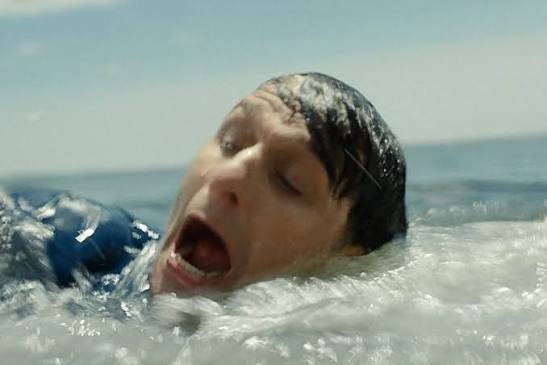
A New England island down on its luck, whose transformation into a tourist destination early on helps stir up ancient horrors, Widow’s Bay does soak its genre moves in the salty brine. There’s not a lot of fishing going on, for cod or Leviathans, though the first sign of horror in the series is the strange fate of a zombified fisherman. The grizzled local boat captain, Wyck, is the voice of supernatural convictions, who warns the hapless secular mayor Tom Loftis that the witchy figure he saw lumbering toward him one night was indeed a sea hag. Later, as the mayor takes the first honorary swim in the bay for the opening day of summer season, the hag claws him from below, a supernatural attack that the beach crowd does not perceive as such. In ways both smart and silly, then, Widow’s Bay occupies another shoreline: that classic Mulder-Scully liminal zone between the solid ground of conventional truth and the seas of potentially supernatural experience.
And that’s not the only spooky demarcation on the island. Because of demonic doings back in the Colonial era, whose haunted details add a depth that would otherwise be lacking in this sometimes paper-thin show, nobody born on the island can leave the place without perishing. But where exactly is the fatal border located? As the old chaos scientists were fond of pointing out, coastlines are too fractal to ever truly nail down. So at Widow’s Bay, the cage of the curse lies just off shore, in the water, solid enough to get marked on Wyck’s map, but still as indefinite as the sea, the most boundless of boundaries.
NETS OF TIME
One of the most uncanny contributions to the Littoral Weird of late is the British filmmaker Mark Jenkin’s 2025 film Rose of Nevada. The title names a ghostly fishing boat that floats into a depressed Cornish fishing town thirty years after the boat and its crew were lost at sea. Two young locals sign on to the new operation and learn the art of fishing, which is vibrantly detailed here in all its grueling slime. (“Gut them from head to asshole,” their grizzled Popeye-like captain instructs.) But when the young men return to port they find they have slipped back in time to the 1990s, where they find themselves living the lives of the men lost in the original accident. This scenario, which one of the men resists with mounting horror and the other enjoys, sets up all manner of awkward enigmas of longing and loss. It also allows Jenkin to reflect on sacrifice, community memory, economic cycles, and the eternal return of fishermen at sea.
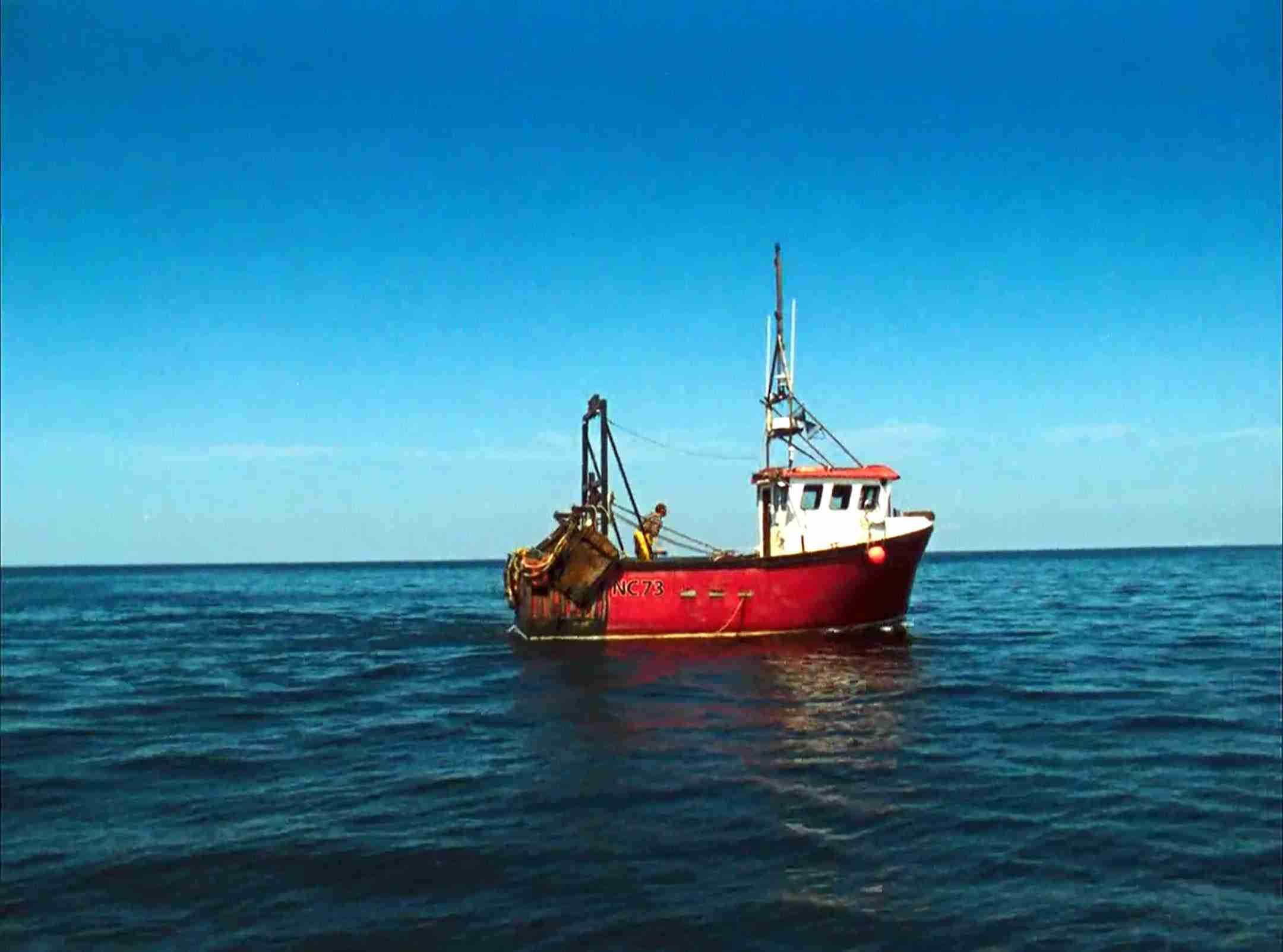
Jenkin has been making low-budget independent films, shorts and features, since the 1990s. As British critics have come to recognize, he is simply a phenomenal filmmaker, with a fresh visual style that’s saturated with cinematic art, and a thematic voice that is poetic and scruffy and sodden with the stormy coastlines he grew up on.
Thanks to the sub-sub-librarians of the Internet, I found my way to a small torrent of experimental shorts, essay films, music videos, and features. I discovered that, for over a decade, Jenkin has restricted himself to shooting on 16 mm, both black-and-white and Kodak film, usually using a cranky 1976 Bolex clockwork camera that finally crapped out during the filming of Rose. Though Jenkin edits in digital, the grainy tangibility of 16 mm allows him to go to town with an “experimental” visual approach to textures, color saturation, and visual abstraction. The first minute of Rose, for example, features a series of static, intimately composed shots of corroded seaside bric-à-brac, gorgeous images of marine decay that are at once non-objective and concretely present. The anachronistic timeslip of 16 mm also speaks to Jenkin’s abiding themes, the cellulose almost magically incarnating his obsession with the traces of the past, the strange loops of time, and the vexed attractions of nostalgia. Experimentalism often results in emotional distancing; instead, Jenkin roots the rough abstractions of his visual style in a very particular sense of character and place.
It helps that the place in question is Cornwall, where Jenkin was born and raised, and where he now lives again. (He is a direct descendant of Alfred Wallis, a Cornish fisherman and important primitive painter.) I have been blessed to spend a fair amount of time in Cornwall, which ranks in my ledger as one of the more enchanting places in the world. Not unlike Appalachia in the American imagination, Cornwall has in the past been thought of as an ignorant backwater, a faraway place of gnarled nature and poor-ass rustic ways. More recently, of course, it has become the object of tourist fantasy and second-home colonization — an economic and cultural tension that drives a number of Jenkin’s films, including his breakout 2019 feature Bait.
For Jenkin, the central figure for Cornish identity is the fisherman. In his short film “The Essential Cornishman,” Jenkin delivers a Beat-worthy rap in the grainy rapid-fire diction of a newsreel announcer from the middle of last century. The essential Cornish fisherman is “effortless and aloof, magnetic, the last great hunter who takes aim in the deep, unaware of or too modest to acknowledge the essential nature of his being.” Here is part of the work:
In Bait, Jenkin weds this almost mythic sense of respect with a gritty contemporary portrait of precarity, resentment, and purchaseless honor. The protagonist Martin, too poor to own his own boat, draws in his nets from the shore, where he is forced to watch Londoners decorate the family home he sold them with nautical themed kitsch. Jenkin is not a black-and-white thinker; there are always cracks and hairs in the frame. As such, there are no heroes or villains here, no pure traditions, no formulas. The actors move through the story with a sense of improvised, devil-may-care panache that makes Bait a briny nouvelle vague film for Brexit times.
As is his wont, Jenkin brings attention to the specific life of things — boots, nets, knives, pint glasses — that co-exist with humans in the world of Bait. This everyday animism, along with the appearance of a mysterious older fisherman and some ominous flashforwards, lend Bait a spooky quality that had some fans hoping for something more explicitly supernatural from Jenkin. And they got it. In the enigmatic Enys Men (2022), a volunteer naturalist, played by Jenkin’s real-life partner Mary Woodvine, temporarily lives in an abandoned house on an otherwise uninhabited island, where she is monitoring a strange flower. Her daily routines begin to loop her into a deeper ritual that intensifies until ghostly human figures flicker in and out of view, and fragments of the previous lives (and deaths) of the island return. Watching over it all is the figure of Boswens Menhir, a standing stone that is, in reality, found on the Cornish mainland.
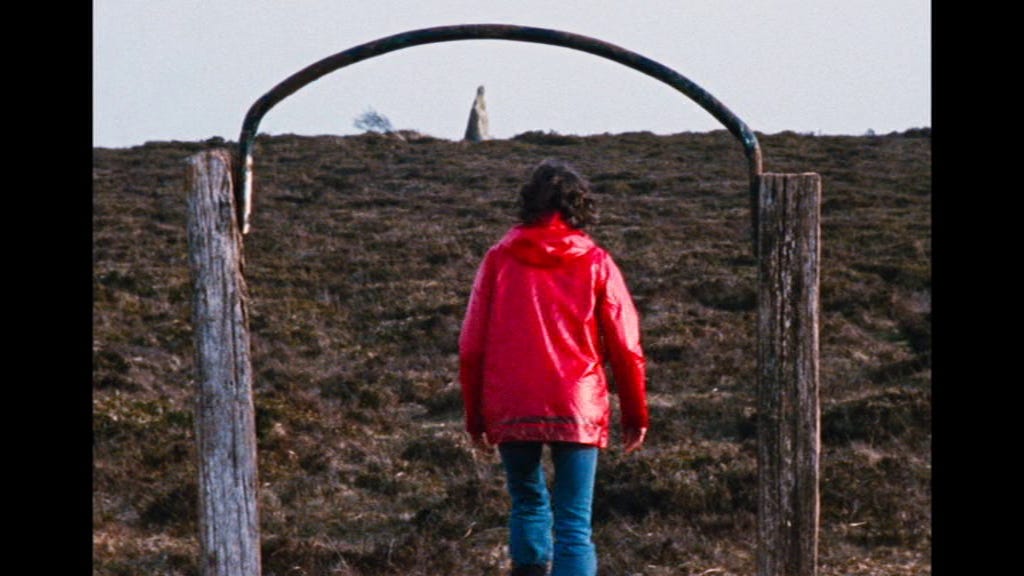
By the end, things get weird in a way that justifies the “folk horror” tag given the film. To judge from many of the negative reviews online, however, it seems that a lot of viewers felt ripped off in the end, which perhaps demonstrates my earlier point about the legibility of formulas. Too much enigma, too much “experimentalism,” and we break the genre contract. While Enys Men is not a masterpiece, it demonstrates how a director can craft enigma not only through images but through formal features like juxtaposition, repetition, color, and pacing. (For another brilliant British example, see Nicolas Roeg’s Don’t Look Now (1973), whose famous red mackintosh makes an apparently unintentional return in Enys Men.) In the end, Jenkin leaves us nothing more than a tangled net of implication — distress calls, drowned sailors, dancing milkmaids, lichens, miners. I got goose bumps aplenty, but they were not catalyzed by jump cuts or chilling reveals or anything like narrative resolutions.
We get something similar in Rose of Nevada, a more robust and successful enigma film. (Online it’s mostly classed, stupidly, as Sci-Fi — because time travel is “science-y” I guess?) Here is the anti-spoiler, folks: the time slip is never explained. Towards the end of the film, however, there is the intimation that some sort of community ritual is involved, something required for the continued bounty of the sea, a ritual that may be linked to an enigmatic scene of fishermen collectively mending nets. But it’s we who have been caught in a net of ties and splices. The hypnotic and jumpy editing throughout the film has already prepared us for the same atmosphere of dread recurrence that marks Enys Men, a sense of being swallowed up in a narrative the beginning or end of which you cannot see — a narrative that might be history, that might be myth. Or maybe this sense of untimely return is just the way that the ancient analog world speaks to us at this late digital date. In all these texts, this gone world may be best rendered as that most primary of planetary psychogeographies: the great ocean, described by Jenkin in “The Essential Cornishman” as “the water that doesn’t age, that won’t date like a photo dates…”
I hope you enjoyed this flicker of Burning Shore. More than anything, I want to resonate with readers. If you would like to show support, the best thing is to subscribe and to forward my posts to friends or colleagues. You are also welcome to consider a paid subscription, and you can always drop an appreciation in my Tip Jar.
For more of the "eternal Cornishman" myth, try the 1951 documentary on the Padstow Hobby Horse: https://youtu.be/ISO1QmG_VE4?si=d_uyAYHJOaTUXTaz
The kicker is Mr. Eternal down on the pier with his accordion is, in fact, the very folklorist involved in pushing the notion of Hobby Horse as incredibly ancient.
The line about genre being smarter than the writer using it is the one I'll be borrowing, and probably not crediting properly.
On the Mesopotamian side there's a detail that might sharpen the Adorno reading. In Enūma eliš the primordial sea is doubled — Apsû the fresh water, Tiamat the salt — and Ea kills Apsû and then builds his dwelling on top of him. The hero doesn't leave the chaos behind, he moves in above it. And the Ugaritic Lôtān of the Baal cycle turns up almost verbatim as liwyātān in Isaiah 27:1, so there's a traceable path rather than a bubbling-up. What gets me is that Enki, lord of that same freshwater deep, is also the god who shapes people out of clay. The water is where the chaos lives and where the workshop is.
If genre is already a kind of AI, when did it become executable? Propp and the pulp house style sheets, or were the rhapsodes running it all along?